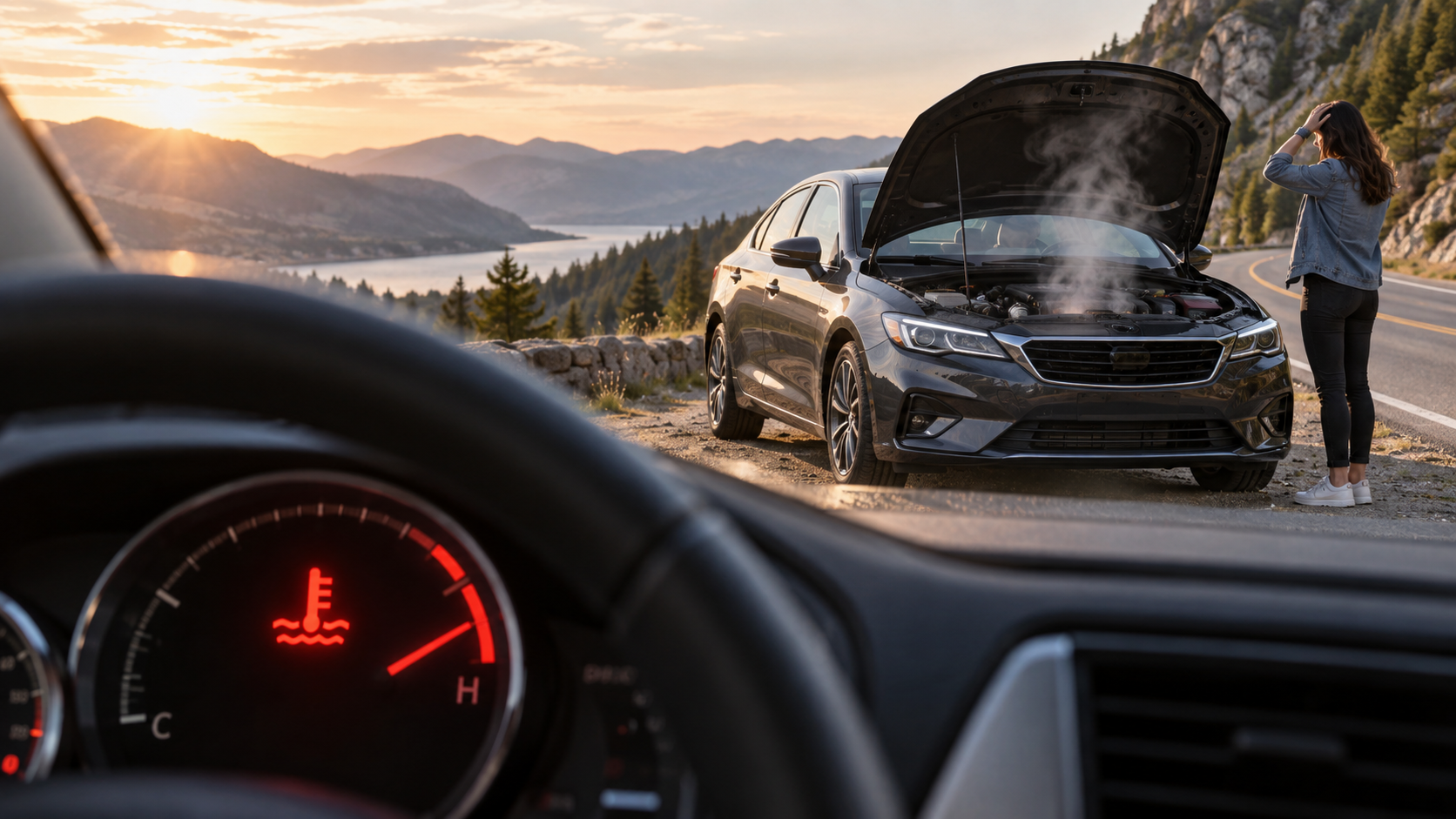
You are driving normally when a warning suddenly appears: engine coolant over temperature.
Maybe the temperature gauge is climbing toward the red zone. Maybe you hear a warning chime. The air conditioner may stop blowing cold. In a worse case, you notice steam near the hood.
This is one dashboard message you should take seriously.
An engine coolant over temperature warning means the engine’s cooling system has detected temperature above its expected operating range. Sometimes the cause is relatively simple, such as low coolant. Other times it points to a failed water pump, stuck thermostat, cooling fan problem, leaking hose, blocked radiator, or another fault that can quickly lead to engine damage.
The important part is not figuring out the exact cause while sitting in traffic. First, protect the engine and get the vehicle somewhere safe.
What Should You Do First?
If the temperature warning appears while you’re driving, pay attention immediately.
If you’re in moving traffic, don’t panic and don’t make a sudden unsafe stop. Reduce engine load and find a safe place to pull over.
- Turn off the air conditioner.
- Move safely out of traffic as soon as practical.
- Watch the temperature gauge if your vehicle has one.
- Stop the engine if the temperature remains high or continues rising.
- Do not open a hot radiator or pressurized coolant cap.
- Wait for the engine to cool before inspecting coolant levels.
- Arrange towing if overheating returns or coolant is leaking heavily.
If steam is pouring from under the hood, the warning is flashing red, or the engine begins running poorly, continuing to drive can turn a manageable repair into a major engine job.
Why Engines Need a Cooling System
An internal-combustion engine creates a lot of heat.
Some of that heat is useful because engines are designed to operate within a particular temperature range. Too cold isn’t ideal either. But too much heat can damage oil, seals, gaskets, aluminum components, cylinder heads, and other expensive parts.
Coolant circulates through passages in the engine and absorbs heat.
The water pump moves that coolant through the engine and radiator. Air passing through the radiator removes heat. A thermostat regulates coolant flow according to engine temperature, while electric fans provide extra airflow when road speed alone isn’t enough.
It is a simple idea with several components working together.
If one important part stops doing its job, engine temperature can climb surprisingly fast.
Common Causes of Engine Coolant Over Temperature
| Possible Cause | What Happens | Typical Clues |
|---|---|---|
| Low coolant | There is not enough coolant to carry heat away efficiently | Low reservoir level, heater problems, visible leaks |
| Coolant leak | Coolant escapes from the system | Puddles, sweet smell, wet hoses or engine components |
| Failed thermostat | Coolant flow may be restricted | Temperature rises quickly, upper radiator hose behavior may seem abnormal |
| Cooling fan problem | Radiator gets too little airflow at low speed | Overheats in traffic but improves on the highway |
| Water pump failure | Coolant circulation becomes weak or stops | Overheating, leaks, bearing noise, poor heater output |
| Blocked radiator | Heat cannot escape efficiently | High temperature under load, uneven radiator temperatures |
| Damaged drive belt | Belt-driven water pump may stop turning | Battery warning, squealing, sudden temperature rise |
| Air trapped in the system | Coolant circulation becomes inconsistent | Temperature swings, gurgling, poor cabin heat |
| Head gasket failure | Combustion pressure or coolant can move where it should not | Coolant loss, overheating, bubbles, white exhaust in some cases |
Low Coolant Is One of the First Things to Check
A cooling system cannot work properly without enough coolant.
Low coolant may happen because of a leak, improper service, gradual loss from a failing component, or air being pushed out after recent cooling-system work.
If the engine is completely cool, inspect the coolant reservoir.
Many reservoirs have MIN and MAX markings. The coolant level should normally sit within the range specified by the vehicle manufacturer.
Do not assume topping it off solves the problem.
If coolant is low, ask why.
A sealed cooling system should not require constant refilling. If you add coolant every few weeks, there is likely a leak or another underlying issue.
Never Open a Hot Cooling System
This point deserves its own section because the risk is real.
Hot cooling systems are pressurized.
Coolant can remain well above the normal boiling point of water while pressure keeps it in liquid form. Remove a radiator cap or pressurized reservoir cap while everything is hot, and that pressure can drop suddenly.
Superheated coolant may erupt as steam and boiling liquid.
Serious burns can happen in seconds.
If the engine has overheated, give it time to cool. Follow the owner’s manual for the correct inspection procedure.
Could a Bad Thermostat Cause the Warning?
Absolutely.
The thermostat controls when coolant is allowed to circulate more fully through the radiator.
When the engine is cold, the thermostat remains closed or partially closed so the engine warms efficiently. As temperature rises, the thermostat opens.
If it becomes stuck closed, hot coolant may remain trapped in the engine instead of flowing through the radiator.
Temperature can rise quickly.
A thermostat can also fail in other ways, so replacement should be based on diagnosis rather than assumption.
Cooling Fan Problems Often Show Up in Traffic
Here’s a useful clue: does the vehicle run hot while sitting in traffic but cool back down once you’re moving at highway speed?
That pattern often puts radiator airflow high on the suspect list.
When the car is moving, natural airflow passes through the radiator.
At a stoplight, that airflow mostly disappears. Electric radiator fans need to take over.
If a fan motor, fuse, relay, wiring circuit, temperature sensor, control module, or fan assembly has a problem, the engine may overheat during low-speed driving.
Then you get moving again, airflow increases, and the temperature begins dropping.
That’s not proof of a fan failure, but it’s a strong diagnostic clue.
What If the Car Overheats Mostly on the Highway?
Overheating at highway speed points the investigation in a different direction.
At 60 or 70 mph, airflow through the radiator should be strong. So if temperature still climbs, the system may have a coolant-flow or heat-transfer problem.
A weak water pump, restricted radiator, thermostat problem, low coolant level, trapped air, internal engine issue, or poor coolant circulation can all become suspects.
Heavy loads matter too.
Towing, long uphill climbs, high outside temperatures, and extended high-speed driving increase the amount of heat the cooling system must remove.
The Water Pump Is Critical
The water pump keeps coolant moving.
When it begins failing, the engine may overheat even though the radiator is full and the fans work properly.
Some pumps leak externally through a seal or weep hole. Others suffer bearing failure. Certain modern pumps have plastic impellers that can become damaged or loose internally.
That creates a frustrating situation because the pump may appear to spin while coolant circulation is poor.
Some modern engines also have electric water pumps rather than traditional belt-driven units.
An electronic pump can fail mechanically, electrically, or because of a control-system problem.
A Broken Belt Can Create Multiple Warnings
On engines where the accessory belt drives the water pump, belt failure can quickly lead to overheating.
The same belt may also drive the alternator.
So you might see a battery warning followed by an engine coolant over temperature message.
If hydraulic power steering shares the belt, steering can suddenly become much heavier too.
That combination is a major clue.
A missing or broken belt means driving farther may damage the engine very quickly if the water pump is no longer turning.
What About the Radiator?
The radiator has one job: dump heat into the surrounding air.
It can become less effective for several reasons.
Internally, deposits or contamination can restrict coolant flow.
Externally, dirt, leaves, bugs, bent fins, plastic bags, or debris can block airflow.
Older radiators can also develop leaks around seams, tanks, or connections.
A partially restricted radiator may work well enough during light driving but struggle on a hot day, during towing, or while climbing a long grade.
Can the Wrong Coolant Cause Overheating?
Possibly.
Vehicle manufacturers specify particular coolant chemistry for a reason.
Different coolants contain different corrosion inhibitors and are designed for particular materials and service intervals.
Mixing incompatible coolants can sometimes create deposits or sludge that reduce cooling performance.
And filling the system with an incorrect mixture can affect freeze protection, boiling protection, and corrosion resistance.
Do not rely only on coolant color.
Color is not a universal specification.
Check what your vehicle actually requires.
Can Plain Water Be Added in an Emergency?
If the engine is completely cool and the cooling system is genuinely low, plain water can sometimes serve as an emergency temporary measure when the correct coolant is unavailable.
But it is not the preferred long-term fill.
Proper coolant provides corrosion protection, lubrication for certain cooling-system components, freeze protection, and improved boiling resistance when mixed at the correct concentration.
If you had to add water during an emergency, have the mixture corrected afterward.
And again, never remove a pressurized cap from a hot system.
Why the Heater Sometimes Goes Cold Before the Engine Overheats
This is a surprisingly useful clue.
Your cabin heater normally gets its heat from hot engine coolant flowing through the heater core.
If the coolant level becomes very low or circulation stops, the heater core may no longer receive hot coolant.
You may notice the vents suddenly begin blowing cool air even though the engine temperature gauge is rising.
That combination can point toward coolant loss or poor circulation.
If the heater goes cold while the engine gets hotter, take it seriously.
Can Turning the Heater On Help?
In some situations, turning the cabin heat to maximum can remove a small amount of extra heat from the cooling system because the heater core acts like a miniature radiator.
But this should be viewed as a temporary measure while getting to a safe stopping point, not as a repair.
If the engine is genuinely overheating, the solution is not driving another 30 miles with the heater blasting.
Pull over safely and deal with the problem.
Signs You Should Stop Driving Immediately
- The temperature gauge enters the red zone.
- Steam is coming from under the hood.
- The warning remains active after reducing engine load.
- The engine begins knocking, pinging, or running poorly.
- You see a large coolant leak.
- The heater suddenly blows cold while engine temperature rises.
- The battery warning appears at the same time.
- You smell a strong sweet coolant odor.
- The warning returns quickly after the engine cools.
At that point, towing is usually cheaper than gambling with the engine.
What Happens If You Keep Driving an Overheated Engine?
This is where a relatively ordinary cooling-system repair can become painfully expensive.
Excessive heat can distort metal components.
Aluminum cylinder heads are especially sensitive to severe overheating. Gaskets can fail. Engine oil can lose some of its protective ability at extreme temperatures. Plastic cooling-system parts can soften or crack.
In severe cases, pistons can scuff, cylinder heads can warp, or the engine can seize.
The difference between stopping quickly and continuing “just five more miles” can be thousands of dollars.
Can Overheating Blow a Head Gasket?
Yes.
Severe overheating can damage the head gasket or distort the cylinder head enough that the gasket can no longer seal correctly.
But the relationship can run in the other direction too.
A failed head gasket can cause overheating.
Combustion gases may enter the cooling system and create abnormal pressure. Coolant may enter the cylinders or oil passages. The cooling system may repeatedly lose coolant without an obvious external leak.
That is why repeated overheating deserves proper diagnosis.
Possible Head Gasket Warning Signs
A head gasket problem can produce several symptoms, but no single one proves the diagnosis.
You might see repeated coolant loss, unexplained cooling-system pressure, persistent bubbles in the reservoir, overheating, contaminated oil, coolant in a cylinder, or white exhaust vapor after the engine has warmed.
Some gasket failures are subtle.
The engine may run normally most of the time and only overheat during longer trips.
Testing may involve cooling-system pressure checks, combustion-gas testing, leak-down testing, compression testing, or other procedures depending on the symptoms.
Why Air Pockets Cause Trouble
Cooling systems need coolant where coolant is supposed to be.
After a thermostat replacement, radiator repair, hose replacement, or coolant service, air can remain trapped inside the system if it is not filled and bled correctly.
Air pockets can interfere with circulation and temperature sensing.
Some cars are fairly easy to bleed. Others have specific fill procedures, bleed screws, vacuum-fill recommendations, or electronically controlled pumps that require a service routine.
If the overheating started right after cooling-system work, trapped air should be considered.
Can a Bad Temperature Sensor Trigger the Warning?
Yes, an inaccurate coolant temperature sensor or wiring fault can sometimes report an incorrect temperature.
But don’t assume the sensor is lying just because the engine seems fine.
The safest approach is to verify actual engine temperature through diagnostic data or other proper testing.
A genuine overheating problem can exist before you smell coolant or see steam.
The warning deserves verification rather than dismissal.
Why Modern Cars May Reduce Power During Overheating
Some vehicles try to protect themselves when coolant temperature becomes too high.
The engine control system may reduce air-conditioning operation, limit engine power, increase cooling-fan speed, change transmission behavior, or display additional warnings.
Some engines can even modify operation to reduce heat temporarily.
These protective strategies may help prevent immediate damage, but they are not permission to keep driving indefinitely.
If the system says the engine is too hot, something needs attention.
What a Repair Shop Will Usually Check
A good cooling-system diagnosis starts by verifying the complaint rather than replacing whichever part seems most obvious.
The technician may check coolant level, visible leaks, fan operation, cooling-system pressure, thermostat behavior, radiator condition, water pump operation, belt condition, sensor data, and stored fault codes.
The system may also be pressure-tested.
A pressure test can reveal leaks that are difficult to see when the engine is cold.
If no external leak is found but coolant keeps disappearing, internal leakage may require further testing.
What Different Overheating Patterns Can Tell You
| When It Overheats | Possible Area to Investigate | Why |
|---|---|---|
| Mostly at idle | Cooling fans or airflow | Natural airflow is low when the car is stopped |
| Mostly on highway | Coolant circulation or radiator capacity | Airflow should already be strong |
| During long uphill climbs | Cooling system under heavy load | Engine produces more heat under sustained load |
| Right after coolant service | Air trapped in system | Improper bleeding can interrupt circulation |
| Immediately after cold start | Sensor fault or severe circulation problem | Normal engines need time to reach high temperature |
| Randomly, then normal again | Thermostat, fan, wiring, pump, or air pocket | Intermittent faults can come and go |
| With coolant constantly disappearing | External or internal leak | The system is losing coolant somewhere |
| With battery warning | Accessory belt problem | Belt may drive both alternator and water pump |
What Not to Do When the Engine Is Overheating
- Do not open a hot radiator or coolant cap.
- Do not continue driving simply because the car still feels normal.
- Do not pour cold water onto a very hot engine.
- Do not keep topping off coolant without finding the leak.
- Do not assume a new thermostat will automatically fix the problem.
- Do not ignore a temperature warning that disappears and comes back.
- Do not work near moving belts or fans with the engine running.
- Do not assume an electric fan is safe just because the engine is switched off; some fans can start automatically.
How Long Should You Wait Before Checking Coolant?
There is no universal five-minute rule.
A severely overheated engine can remain dangerously hot and pressurized for quite a while.
Wait until the engine has cooled substantially and follow the owner’s manual.
If you’re unsure, waiting longer is safer.
Never judge pressure only by touching the hood.
The cooling system can still be hot while exterior surfaces feel less dramatic.
Should You Restart the Engine After It Cools?
Sometimes a vehicle can be restarted after cooling, particularly if you need to move it a very short distance to a safer position.
But if the coolant reservoir is empty, there is a major visible leak, the belt is missing, or the warning returns almost immediately, shut it down.
Driving farther may not be worth the risk.
If the cause isn’t obvious and the vehicle already overheated severely, towing is the safer option.
Can Overheating Damage Engine Oil?
Yes.
Engine oil is designed to work across a wide temperature range, but severe overheating can push it beyond normal conditions.
High temperatures can accelerate oil breakdown and reduce its ability to protect internal parts.
After a serious overheating event, a technician may recommend checking the oil and, depending on the situation, replacing it.
If coolant has mixed with the oil, that is a more serious issue and should be diagnosed before continued operation.
What If the Warning Appears but the Gauge Looks Normal?
Do not automatically trust one display over another.
Modern vehicles may calculate warnings from sensor data that does not exactly match a simplified dashboard gauge.
Some temperature gauges are also heavily damped, meaning they remain near the middle over a fairly broad temperature range.
Scan-tool data can reveal the actual coolant temperature being reported by the engine computer.
If a warning appears repeatedly while the gauge looks normal, the system still deserves investigation.
Can Air Conditioning Make the Engine Overheat?
Air conditioning adds load to the engine and increases the amount of heat being handled around the radiator and condenser area.
A healthy cooling system is designed to handle that.
But if the system is already marginal, turning on the A/C may expose the weakness.
For example, a weak cooling fan may become obvious when the A/C is running in slow traffic.
Turning the A/C off can slightly reduce the load while you move to a safe stopping point.
Why Hot Weather Exposes Cooling Problems
Summer heat does not normally cause a healthy vehicle to overheat.
Cars sold in the United States are designed to operate across a wide range of temperatures.
But hot weather reduces the cooling system’s margin.
A partially blocked radiator, weak fan, low coolant level, aging thermostat, or worn water pump may survive cooler spring weather and struggle once outside temperatures climb.
That’s why cooling-system failures often seem to arrive out of nowhere during the first serious heat wave.
Can Towing Cause an Engine Coolant Over Temperature Warning?
Towing increases engine load considerably.
The engine works harder, the transmission may produce more heat, and the cooling system has to remove additional thermal energy.
If the vehicle is operating within its rated towing limits and the cooling system is healthy, it should still remain within its designed temperature range.
If overheating occurs repeatedly while towing, check the cooling system and confirm that the trailer weight and operating conditions are within the vehicle’s specifications.
Can Low Engine Oil Cause Overheating?
Engine oil helps control internal friction and carries some heat away from moving parts.
A dangerously low oil level can therefore contribute to excessive engine temperature and serious mechanical damage.
But most engine coolant over temperature warnings are still related primarily to the cooling system.
If both an oil-pressure warning and overheating warning appear, stop the engine as soon as it is safe.
What About Hybrids?
Hybrid vehicles can have more than one cooling circuit.
The gasoline engine may have a conventional coolant loop, while the inverter, electric motors, battery, or other high-voltage components can have separate thermal-management systems.
A temperature warning on a hybrid should therefore be interpreted according to the exact message displayed.
High-voltage cooling-system work requires appropriate training and safety procedures.
And Electric Vehicles?
Electric vehicles don’t have a traditional gasoline engine, but they still rely heavily on thermal management.
Battery packs, drive motors, power electronics, and cabin systems can all depend on coolant loops.
An EV temperature warning can therefore be serious even without an internal-combustion engine.
The appropriate response depends on the exact warning and vehicle model.
Follow the manufacturer’s instructions rather than treating every coolant message as if it came from a traditional engine.
Can Regular Maintenance Prevent Overheating?
Not every failure can be predicted, but maintenance lowers the odds of an unpleasant roadside surprise.
Coolant should be replaced according to the vehicle’s maintenance schedule.
Belts and hoses should be inspected. Coolant leaks should be repaired instead of repeatedly topped off.
If the temperature gauge starts behaving differently than usual, investigate early.
A small leak today is much cheaper than a warped cylinder head next month.
FAQ
What does engine coolant over temperature mean?
It means the vehicle has detected engine coolant temperature above its expected operating range. The engine may be overheating because of low coolant, poor circulation, airflow problems, a leak, or another cooling-system fault.
Can I keep driving with an engine coolant over temperature warning?
Continuing to drive can damage the engine. Move safely out of traffic, stop the engine if the temperature remains high, and investigate the cause before continuing.
Can I add coolant when the engine is hot?
Do not open a hot pressurized cooling system. Hot coolant can spray out and cause severe burns. Wait for the engine to cool and follow the vehicle manufacturer’s procedure.
Why does my car overheat in traffic but not on the highway?
This pattern often points toward inadequate radiator airflow, such as a cooling fan problem. Other faults are still possible, so the cooling system should be tested.
Can a thermostat cause an engine coolant over temperature warning?
Yes. A thermostat that remains closed or does not open correctly can restrict coolant flow through the radiator and cause engine temperature to rise.
Why is my coolant low if I don’t see a leak?
A leak may appear only when the system is hot and pressurized, or coolant may be escaping internally. Pressure testing and further diagnosis may be needed.
Will an overheated engine be okay after it cools down?
Sometimes, but cooling down does not remove the cause. If the engine overheated severely or the warning returns, have the vehicle inspected before driving farther.
Conclusion
An engine coolant over temperature warning is not something to save for later.
The car is telling you that engine temperature has moved outside the range the cooling system is supposed to maintain.
And while the cause may be as ordinary as low coolant or a failed cooling fan, continuing to drive an overheated engine can create much more serious damage.
First, get somewhere safe.
Switch off the air conditioner. Reduce engine load. If temperature continues climbing, stop the engine.
If you see steam, a large coolant leak, a red temperature warning, or other serious symptoms, don’t keep going simply because the engine still runs.
Then wait.
A hot cooling system can remain under pressure long after you’ve parked. Never open the radiator or another pressurized coolant cap while the system is hot.
Once everything has cooled properly, basic observations can help.
Is the reservoir empty?
Is there coolant underneath the car?
Did the battery warning appear at the same time?
Does the accessory belt look intact?
Did the heater suddenly stop producing warm air?
Did the overheating happen only while idling in traffic, or did it happen at highway speed?
Those details give a technician useful direction.
Overheating at idle can suggest an airflow or cooling-fan issue. Overheating at highway speed can shift attention toward coolant flow, radiator performance, thermostat operation, or water pump condition.
Coolant disappearing repeatedly points toward a leak.
A warning that appears after recent coolant service can raise suspicion of trapped air.
And a battery warning combined with a rapid rise in engine temperature may point toward a broken accessory belt on vehicles where that belt drives the water pump.
The cooling system is made of several parts, and guessing can get expensive.
Replacing a thermostat will not fix a cracked radiator. Installing a new radiator will not help if the water pump isn’t moving coolant. Replacing a fan won’t solve combustion gases entering the system through a failed head gasket.
Diagnosis matters.
It also helps to remember that overheating itself can create additional problems.
Severe heat can damage gaskets, distort aluminum components, stress seals, and reduce engine-oil protection.
So even if the engine cools down and seems normal afterward, a serious overheating event deserves attention.
If the warning returns shortly after restarting, don’t keep repeating the cycle.
Cool down. Restart. Overheat. Cool down. Restart again.
That pattern is not harmless.
Every overheating episode increases thermal stress on the engine.
If you’re dealing with a small leak, fixing it early may mean replacing a hose, clamp, thermostat housing, reservoir, or other relatively ordinary component.
Ignoring it until the engine overheats badly can turn the same problem into cylinder-head work or complete engine replacement.
So when you see engine coolant over temperature, treat the warning as exactly what it is: your opportunity to stop the situation before it becomes much more expensive.
Get out of traffic safely, let the engine cool, don’t open a pressurized system while hot, and find the actual cause before returning to normal driving.
Leave a Reply