



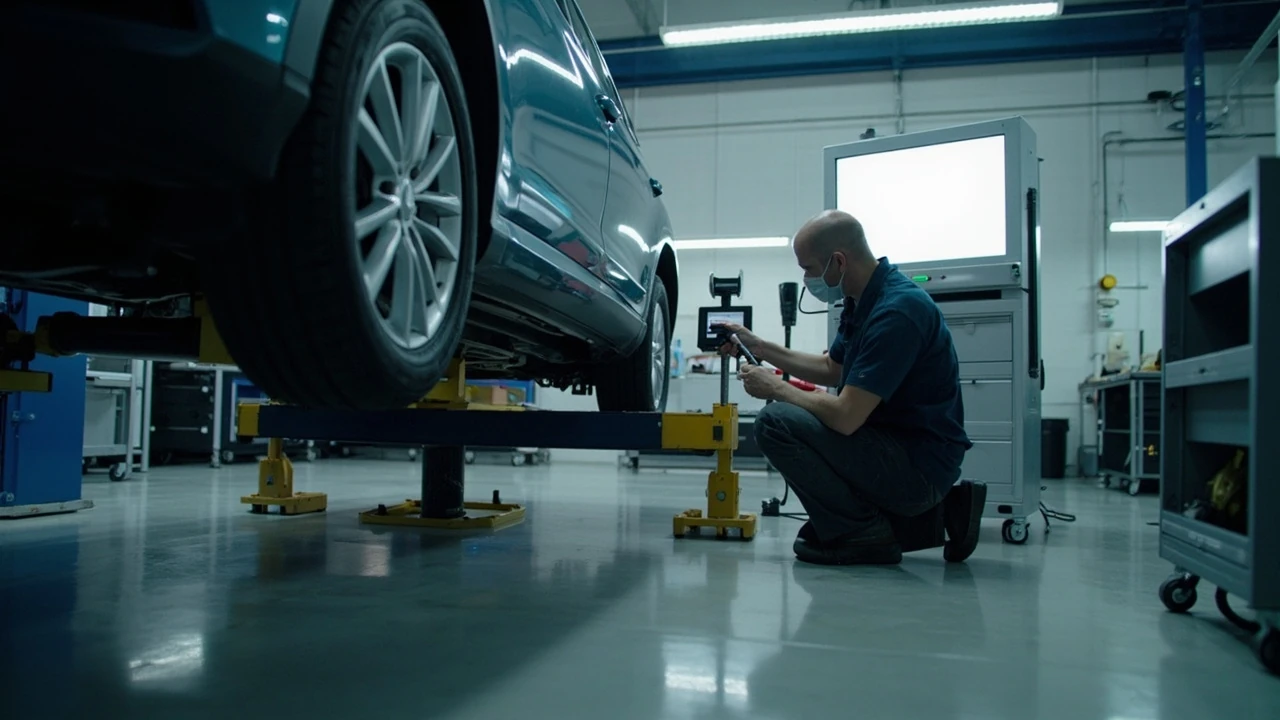

Car wheel alignment: what it is and when you need it
A vehicle that drifts toward one side of the road, steers poorly after a bump, or shows uneven tread wear may need more than a tire rotation. These are common warning signs of improper wheel geometry, and correcting them requires a precise process known as car wheel alignment. The service adjusts the angles created by the suspension and steering components so the wheels point and sit as the manufacturer intended.
Alignment is not the same as balancing a tire, replacing a shock absorber, or rotating tires. Tire balancing reduces vibration by correcting heavy spots on a tire. Alignment changes the relationship between the wheels, the road, and the vehicle body. A car can have balanced tires and still pull to one side if its toe, camber, or caster settings are outside the acceptable range.
Many drivers notice a problem after a pothole, curb strike, collision, suspension repair, or tire replacement. Other vehicles develop alignment issues gradually as components wear. The steering and suspension system contains many joints, bushings, springs, and mounting points, and each can affect how the wheels sit. For a broader look at how mechanical symptoms should be investigated, see Power Steering Pump Replacement: What You Need to Know before assuming that every handling complaint comes from the alignment equipment.
This guide focuses on one practical decision: when alignment is worth checking, what a proper service should include, and how to tell whether the work was done correctly. It also explains what information a driver can gather before visiting a shop.
Signs that your vehicle may need wheel alignment
The clearest sign is a change in the vehicle’s behavior compared with how it normally drives. Alignment issues commonly affect straight-line stability, steering response, and tire wear. Because several mechanical problems can create similar symptoms, the driver should look for a pattern rather than react to one isolated event.
Common symptoms
- Pulling to one side: The vehicle tends to move left or right while the steering wheel appears straight.
- Uneven tire wear: One edge of a tire wears faster than the other, or the center and outer rows wear differently.
- Steering wheel that does not return to center: After a turn, the wheel remains turned slightly instead of straightening naturally.
- Shaking or instability: The vehicle feels unsettled at highway speeds, especially on a straight road.
- Uneven steering response: The vehicle may feel stable when turning one way but vague or inconsistent when turning the other.
- Recent change after service or impact: The vehicle began drifting after a tire replacement, suspension work, suspension modification, or collision repair.
Pulling alone does not prove that alignment is required. A stuck or binding steering component, a seized brake caliper, unequal tire pressure, a damaged wheel, or a problem with the suspension can create a similar result. Uneven tire wear is also not always caused by geometry. Underinflation, overinflation, worn shocks, aggressive cornering, and frequent towing can affect tread life.
| Observed symptom | Possible alignment-related explanation | Other conditions to consider |
|---|---|---|
| Vehicle pulls left or right | Front wheels may not be parallel, or front and rear toe may differ from the specified relationship. | Brake drag, tire pressure, wheel damage, steering linkage, or suspension wear. |
| Inner or outer edge wear is faster | Camber may place more load on one side of the tire. | Inflrequent rotation, worn suspension, incorrect tire pressure, or repeated cornering. |
| Center wear is faster | Overinflation can push the shoulders of a tire away from the road. | Suspension wear and excessive positive camber may also contribute. |
| Steering wheel stays off-center | Toe may be incorrect, causing the wheel to remain turned while the vehicle travels straight. | Mechanical play in the steering wheel, linkage, or steering column. |
| Handling feels unstable | Incorrect caster, camber, or rear toe may reduce stability. | Tire condition, shock or strut performance, wheel balance, or suspension damage. |
Before scheduling alignment, check that all tires have the correct pressure and are securely mounted. Drive on a flat, level road at moderate speed and note whether the vehicle pulls in both directions. If it pulls only during braking, turns, or when brake pedal pressure varies, investigate the brakes before focusing on wheel geometry.
Some warning lights may appear to relate to steering, but an illuminated check-engine light does not identify alignment by itself. Sensors measure several engine and emissions variables, so MAF Sensor Symptoms: What Your Car Is Trying to Tell You can help separate a powertrain or sensor concern from a directional handling problem.
How camber, caster, and toe affect your vehicle
Wheel alignment relies on measurements taken relative to the vehicle and the road. The main alignment angles are camber, caster, and toe. Their names may sound abstract, but each has a visible effect on the way a tire meets the pavement and the way the vehicle responds to steering input.
Camber
Camber describes the inward or outward tilt of a wheel when viewed from the front of the vehicle. If the top of a wheel leans toward the vehicle, it has negative camber. If the top leans away, it has positive camber. Passenger cars generally use modest camber settings because they must support the vehicle, maintain tire clearance, and provide predictable handling. The goal is not to eliminate camber but to keep it within the range specified for that vehicle.
Too much negative camber can concentrate wear on the inner edge of a tire. Too much positive camber can increase wear on the outer edge. The acceptable range depends on the model, suspension design, and intended use. Performance vehicles may use different specifications from ordinary passenger cars.
Caster
Caster describes the forward or backward angle of the steering knuckle when viewed from the side. It is primarily a front-wheel setting because caster contributes to steering feel and the tendency of the steering wheel to return toward center after a turn. Front caster angles on the two sides should normally match.
Unequal caster can contribute to a vehicle pulling or steering inconsistently. Caster may also change after a damaged control arm, subframe, or steering component is replaced. This is why an alignment may be included after substantial suspension or collision repair.
Toe
Toe describes whether the front or rear wheels point inward or outward relative to the vehicle’s centerline. If both wheels on an axle point inward, the toe is positive. If they point outward, the toe is negative. If the wheels are parallel, total toe is zero.
Toe is subtle. Even a small specification measured in fractions of a degree can matter over a long distance. Incorrect front toe may cause pulling, while a mismatch between front and rear toe can reduce straight-line stability. Incorrect rear toe can make the back of the vehicle wander, which some drivers describe as the car not wanting to settle after a turn.
These measurements and their basic relationship to steering behavior are summarized in the overview of wheel alignment geometry, which provides useful background for this point. A useful [car wheel alignment](https://example.com) service does more than make an individual wheel look straight. The technician evaluates the vehicle as a system and compares the measurements with the manufacturer’s specifications.
| Alignment angle | What it measures | Typical effect of an incorrect setting |
|---|---|---|
| Camber | Inward or outward tilt of a wheel from a front or rear view. | Uneven shoulder wear, reduced cornering consistency, or tire contact issues. |
| Caster | Forward or rearward tilt of the steering axis on the front wheels. | Changed steering effort, return-to-center behavior, or directional stability. |
| Toe | Inward or outward direction of the wheels on an axle. | Pulling, wandering, rubbing, or a steering wheel that will not center. |
| Front-to-rear toe relationship | The balance between the front and rear axle settings. | Reduced straight-line stability even when each axle appears close to its own limit. |
Correct alignment is therefore a matter of accepted tolerances, not just three perfect numbers. Each vehicle has a factory range, and the shop needs the correct data for the exact model, trim, suspension, and any relevant modifications.
What happens during a professional alignment appointment
A proper wheel alignment starts with an inspection, not with immediately moving the steering wheel. The technician needs to rule out or identify mechanical problems that would distort the measurements or prevent the adjustments from holding.
1. Vehicle and tire inspection
The service technician should inspect tire condition, tread depth, sidewalls, wheel damage, and inflation. A tire with a deep cut, separated tread, or a severe bulge cannot be safely used as a measurement reference. Uneven wheel or tire construction can also make the equipment report inconsistent readings.
2. Suspension and steering inspection
The technician checks components such as tie rods, ball joints, control arms, bushings, rack-and-pinion components, struts, and wheel bearings. Play in a worn joint may move a wheel while the alignment sensor is attached, making an accurate reading difficult. A loose component must be diagnosed and repaired before the geometry can be trusted.
3. Baseline measurements
The vehicle is positioned on an alignment lift, and sensors are attached to the wheels. The equipment records the current camber, caster, toe, and other available measurements. These readings are compared with the vehicle’s specification.
4. Adjustment
The For additional context, technician loosens fasteners, changes the alignment components, and rechecks each setting. Front and rear axle settings can interact, so adjusting one part may require repeating measurements on another. Vehicles with adjustable rear toe or multiple steering links may take more time to bring into specification.
5. Final verification
After adjustment, the technician tightens fasteners, performs another full measurement, and checks that each setting remains within the manufacturer’s tolerance. The vehicle may then be road-tested to confirm that pulling, wandering, or steering feel has improved. A printout of the before-and-after measurements can be useful documentation when substantial corrections were needed.
| Service stage | What the technician does | What the driver can ask |
|---|---|---|
| Initial inspection | Checks tires, wheels, steering, and suspension for obvious faults. | Were any worn or damaged parts found? |
| Baseline measurement | Records current camber, caster, toe, and related angles. | Can I see the initial readings? |
| Correction | Adjusts alignment components and rechecks the results. | Which settings were outside specification? |
| Final verification | Confirms the readings remain in tolerance after tightening. | Please provide the final measurement report. |
| Road test | Checks straight-line behavior and steering response where appropriate. | What should I watch for during the test drive? |
The appointment should end with the vehicle sitting on the road long enough to settle, because ride height, fuel load, and suspension compression can affect some measurements. A shop that adjusts the wheels while the suspension is hanging can produce readings that do not represent the car in its normal driving position.
How to prepare for your alignment appointment
Preparing the vehicle can prevent wasted time and help the shop diagnose the real issue. It also gives the driver a clearer picture of what happened before the service began.
Record the symptoms
Write down when the problem appears. Note whether the vehicle pulls with the steering wheel centered, whether it wanders after turns, whether the steering wheel returns to center, and which tires show the most wear. If the problem began after a repair, keep the invoice because the shop may need to inspect the work.
Check the basics
- Verify that all tires are inflated to the pressure listed on the driver’s door-jamb placard rather than the number molded into the tire sidewall.
- Confirm that the same tire size and construction are used where the vehicle requires matching tires.
- Look for cuts, bulges, embedded objects, or exposed cords.
- Check whether wheel lug nuts are present and securely tightened.
- Remove excessive mud or debris that could interfere with sensor placement.
Bring the vehicle in the condition you normally drive it
Most passenger vehicles should be driven rather than unloaded on a trailer. Fuel level and cargo can affect ride height, particularly on models with adjustable suspensions. If the vehicle has recently been loaded heavily, tell the technician. If it rides unusually high or low, explain that too.
Share repair history
Alignment may need to be checked after replacing a control arm, strut, tie rod, steering rack, wheel bearing, or suspension bushing. Some parts have fixed positions, while others require measurement and adjustment. If the vehicle was modified with different wheels, taller tires, a lowered suspension, or a lift, disclose that information. The original factory specification may not be the correct target for a modified setup.
A useful pre-visit checklist is:
- Confirm tire pressure and inspect all four tires for visible damage.
- Write down the exact handling complaint and when it started.
- Note any pothole, curb strike, collision, or suspension work that preceded it.
- List modifications such as lift kits, larger tires, or lowered springs.
- Keep the vehicle at its normal ride height and drive it to the appointment when possible.
- Request a final measurement report and explain any warning lights or error codes.
Should you align a car yourself or use a professional?
Wheel geometry is a precision job. Professional equipment and vehicle-specific specifications make a shop the practical choice for most drivers. A do-it-yourself adjustment is more realistic for someone with suitable tools, a level surface, the correct manual, and experience working on steering and suspension components.
What a professional can do that is difficult at home
- Measure all four wheels against vehicle-specific reference values.
- Separate small geometry errors from worn steering and suspension parts.
- Adjust front and rear toe together while accounting for their relationship.
- Check whether adjustments remain within tolerance after tightening.
- Document the results and identify components that still need attention.
Consumer-grade laser or camera alignment tools can help with some adjustments, but their usefulness depends on the equipment, the vehicle, and the operator. A device can display a measurement without automatically proving that the vehicle is safe or correctly adjusted. Factory service information remains essential because generic settings may not match the car.
When a home check may be reasonable
A careful owner may use basic tools to inspect for obviously loose steering fasteners, damaged tires, or parts that have shifted after work. Measuring toe with a tape or homemade gauge is less dependable because small errors, tire deformation, and an uneven surface can distort the result. Adjusting camber or caster without understanding the suspension design can also create a new problem.
Professional service is especially appropriate when:
- The vehicle pulls, wanders, or has severe uneven tire wear.
- A wheel, strut, control arm, tie rod, or steering component was damaged or replaced.
- The vehicle has aftermarket suspension, wheels, or oversized tires.
- Repeated adjustments keep drifting out of specification.
- The cause of steering-related warning lights or diagnostic trouble codes is unclear.
DIY guidance is most useful as preparation and inspection rather than a substitute for a measured, final adjustment. If the vehicle has been lowered, lifted, or modified, consult the instructions for those components and obtain a specification intended for the modified configuration.
What affects car wheel alignment cost
Alignment price varies by location, shop, vehicle design, and the amount of work required. The basic service may involve a complete measurement and adjustment, while a complex repair can include replacing worn parts or correcting damage that shifted the suspension geometry.
Before accepting a quote, ask whether it includes front and rear alignment, a printed before-and-after report, and a road test. Also ask whether the price assumes the suspension and steering components are serviceable. A shop should be able to explain what happens if a worn tie rod, bushing, or damaged wheel is discovered.
| Cost factor | Why it can increase the price | Question to ask |
|---|---|---|
| Vehicle configuration | Some models have multiple steering links, adjustable rear toe, or manufacturer-specific procedures. | Is the quoted procedure for my exact model and trim? |
| Repairs needed first | Loose or damaged components must be addressed before the readings can be trusted. | Will you show me the damaged part and explain the separate repair cost? |
| Wheel or suspension modifications | Aftermarket parts may require different specifications or more extensive adjustment. | Do you use factory specifications or accommodate my modifications? |
| Collision or suspension damage | Damaged mounting points may need repair before the original geometry can be restored. | Can the original specifications be restored, or is another target angle needed? |
| Extra testing | Repeated measurements or additional diagnostics may be needed to find intermittent symptoms. | What testing is included in the initial diagnostic charge? |
A low advertised price may cover a basic front-wheel check, while a complete service costs more. The important distinction is the scope of the work. A legitimate comparison should use the same vehicle requirements and similar services: full measurement, adjustment, final report, and any required road test.
Do not let a shop skip mechanical repairs simply to keep the alignment appointment moving forward. Adjusting around a loose or damaged component may conceal the underlying issue, create an unsafe condition, or prevent the settings from holding. Ask for separate approval before replacing parts unless the shop’s policy clearly allows work to begin after an inspection and a confirmed diagnosis.
What to check after the vehicle is realigned
A completed service should produce a noticeable improvement in the behavior that prompted the visit. The change may not be dramatic if the original misalignment was mild, but the vehicle should track straighter, feel more settled, or show more consistent steering response.
Review the final report
Ask for the final measurements. Compare them with the acceptable range for the vehicle rather than expecting every number to be identical across all four wheels. Some adjustments are designed to match left and right sides, while others allow small differences. The report should show that the relevant settings fall within the specified tolerance.
Road-test the vehicle
On a safe, level road, compare the vehicle with its pre-service behavior. Check straight-line tracking, steering return, response around gentle bends, and whether the steering wheel sits differently after the test. If the vehicle still pulls, make sure tire pressures are correct and note whether the pull is consistent.
It can take a short drive for the driver to recognize the difference, especially if the issue developed gradually. Tire slip and recent suspension work can also affect initial impressions. The next tire replacement is another useful checkpoint because uneven wear patterns should no longer be progressing.
Address remaining problems
Alignment may improve stability but cannot compensate for every mechanical defect. If the vehicle continues to shake, the steering remains noisy, or a tire wears unevenly soon after service, return to the shop and describe the specific condition. Ask them to inspect the parts that were outside the alignment adjustment.
Drivers can protect the corrected geometry by following the vehicle’s tire rotation interval, maintaining proper inflation, avoiding severe impacts, and checking tire wear at regular intervals. If the vehicle carries heavy loads or tow trailers frequently, monitor the tires and steering response more closely. A wheel alignment corrects the current geometry; it does not make worn components immune to future wear.
Frequently asked questions
How do I know if my car needs wheel alignment?
Look for consistent pulling to one side, a steering wheel that does not return to center, wandering over a straight road, or a repeatable uneven tire-wear pattern. Check tire pressure and rule out obvious brake or suspension problems before scheduling the service. A professional measurement can confirm whether any setting is outside the vehicle’s specification.
How long does a car wheel alignment take?
A straightforward alignment inspection and adjustment often takes around an hour, but the exact duration depends on the shop, vehicle, and available equipment. Vehicles with damaged suspension parts, aftermarket modifications, or multiple adjustable components can take longer. A shop should explain any delays after inspecting the vehicle.
Does wheel alignment require replacing tires?
No. Alignment adjusts the wheel geometry and does not automatically require new tires. However, badly worn, unevenly worn, damaged, or incorrectly sized tires can make measurements unreliable or limit the available adjustment. Replace tires when their condition or specifications no longer suit the vehicle and the inspection results.
Can I get a wheel alignment after replacing struts?
Yes, and checking alignment is sensible after replacing struts or shocks because removing suspension components can affect wheel position. Some parts come with preset positioning, while others need a measured correction. Ask the repair shop whether alignment is included or recommended for the specific components and model.
Why does my car pull even though the tires are new?
New tires can make an existing directional problem more noticeable. The cause may be incorrect toe, camber, a worn steering or suspension component, brake drag, low tire pressure, or a bent wheel. If the vehicle pulls consistently, have the steering and suspension inspected before assuming the new tires are defective.
Is rear-wheel alignment necessary?
It depends on the vehicle and its condition. Front alignment addresses the steering wheels, but rear toe and camber also influence stability. Some vehicles have fixed rear settings, while others allow adjustment. A complete measurement can show whether the rear axle falls within its specified range and whether correcting it would improve the vehicle’s behavior.
How often should a vehicle be aligned?
There is no universal interval for every car. Many drivers do not need a scheduled alignment if the vehicle tracks straight, the tires wear evenly, and no major impact or suspension work has occurred. An inspection is sensible after a pothole, curb strike, collision, suspension modification, or relevant component replacement.
Can wheel alignment fix a vibration at highway speeds?
Not always. High-speed vibration is commonly associated with wheel imbalance, tire damage, uneven wear, or loose components, though geometry problems can contribute to instability. Because multiple faults can occur together, describe the speed at which the vibration appears and whether it occurs while accelerating, braking, or coasting so the technician can test the right system.
Will alignment fix uneven tire wear?
Alignment can stop wear caused by incorrect geometry from continuing, but it cannot restore tread already lost. Tires should also be checked for pressure, age, tread depth, and impact damage. Continued uneven wear after a correct adjustment may point to a separate mechanical or loading problem.
What should I ask for after the alignment is finished?
Ask for a final measurement report showing the corrected camber, caster, and toe readings, and compare them with the manufacturer’s allowed ranges. Also request confirmation that any steering fasteners were tightened and ask whether a road test is appropriate. If the original symptom remains, report it clearly and request a follow-up inspection rather than repeatedly adjusting the same components.