


Why is my check engine light flashing?
A flashing check engine light is different from a steady warning. It means the vehicle’s engine-control system has detected a fault that may affect engine performance, emissions, or vehicle safety. Unlike a steady light, which may point to a relatively minor repair, a flashing light calls for immediate attention and should not be ignored during a long drive.
The most common explanation is a severe misfire or another fault affecting how the engine manages combustion. Depending on the vehicle, the same warning can also appear for problems involving wiring, sensors, fuel delivery, or exhaust-system operation. The flashing pattern alone usually cannot identify the failed part. A diagnostic code scan is needed before replacing components.
If the light flashes while the car is moving, the safest response is to pull over somewhere safe, shut the engine off, and avoid continuing to drive until the fault has been identified. A flashing light can, in some cases, be accompanied by a burning smell, rough running, power loss, or overheating. Those symptoms increase the reason to stop and arrange roadside assistance or towing.
This guide explains the most likely causes, the signs that distinguish a flashing light from other dashboard warnings, and the steps a driver can take without turning a warning lamp into an expensive parts-collecting exercise.
How flashing differs from a steady check engine light
Most check engine lights can communicate two broad conditions. A steady light usually means the control system has recorded a fault that should be diagnosed and repaired. A flashing light is treated more urgently because the engine may be operating in a way that could damage a catalytic converter, misfire, overheat, or create a fire risk.
There is one common exception: a brief flash that appears while the key is turned on and then goes out once the engine starts. Many vehicles perform a bulb check during startup to confirm that the warning lamp works. If the light flashes continuously after the engine is running, however, it should be treated as an active fault.
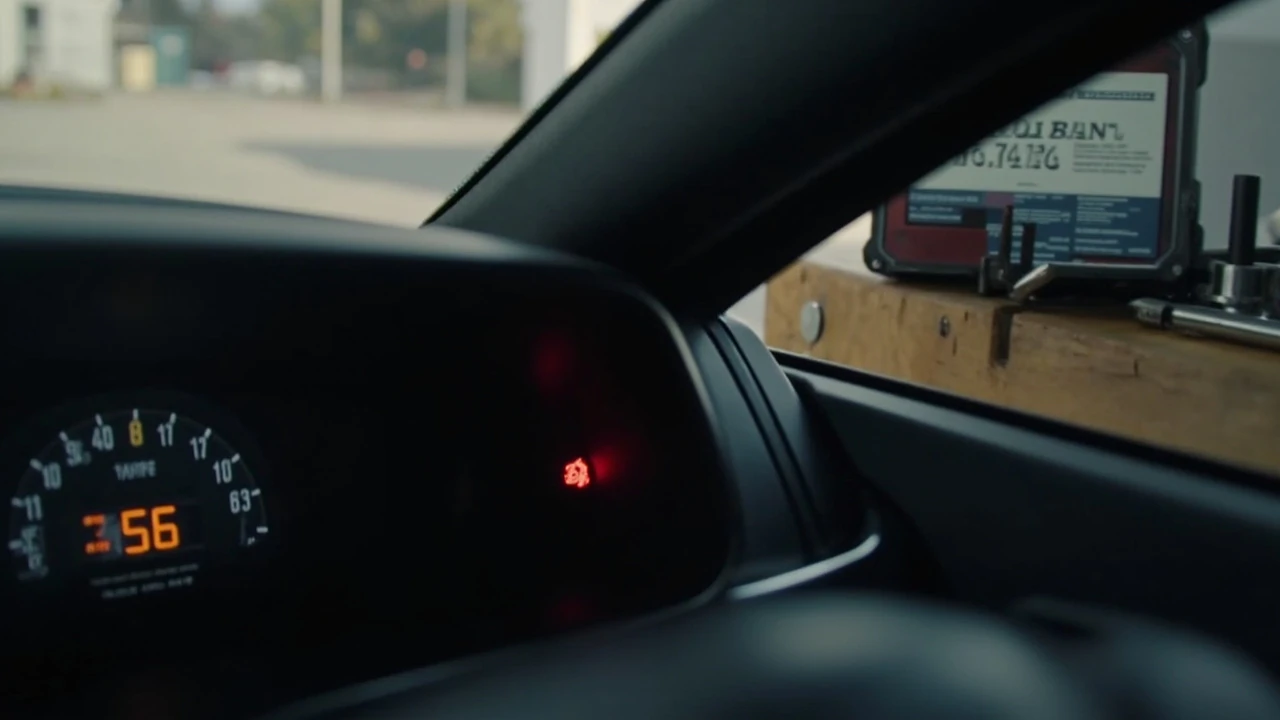
Color can provide another clue, although drivers should follow the instructions in the owner’s manual for the vehicle. An amber lamp commonly identifies a warning, while a red lamp often calls for more immediate action. Some vehicles use separate colors, symbols, or wording for different engine-management problems. The exact behavior varies by make and model, so it is best to identify the actual lamp before assuming it is the standard check engine light.
| Warning behavior | What it commonly means | Recommended response |
|---|---|---|
| Brief flash during key-on, then off when the engine starts | Possible bulb check | Normal if the lamp stays off once the engine is running |
| Steady light with otherwise normal engine operation | A stored fault that still needs diagnosis | Schedule prompt inspection; avoid unnecessary parts replacement |
| Flashing light with shaking, misfire, or power loss | Possible severe engine-management or combustion fault | Stop driving safely as soon as possible |
| Flashing light with burning odor, smoke, or sharp temperature rise | Possible fire or overheating risk | Pull over safely, shut off the engine, and request assistance |
Do not confuse the check engine light with other dashboard warnings. An oil-pressure gauge or warning lamp, a coolant-temperature gauge, a battery voltage message, and a brake-system light can all point to different problems. Some vehicles display several warnings at once, so read the complete cluster before deciding what to do.
What to do immediately when the light starts flashing
The first priority is preventing further damage. If the engine is idling roughly, losing power, shaking, or making unusually loud exhaust noises, pull over at the nearest safe location. If there is a burning smell, visible smoke, or rapidly rising temperature, turn off the engine, move everyone away from the vehicle, and contact emergency services or roadside assistance as appropriate.
Once the vehicle is stopped, follow this sequence:
- Turn off the engine and set the parking brake. Do not repeatedly restart it to see whether the warning returns.
- Look for obvious urgent conditions. Check for visible smoke, fluid leaks, a burning odor, or a warning that the engine is overheating.
- Record what happened. Note whether the car was accelerating, cruising, idling, or decelerating when the light began flashing.
- Check the owner’s manual. Identify the warning symbol and review the vehicle’s instructions for a flashing malfunction indicator.
- Arrange a code scan. A repair shop, mobile mechanic, or properly equipped parts store can usually read stored codes and identify the circuit or system reporting the fault.
- Repair before resuming normal driving. If the vehicle is not roadworthy after inspection, arrange towing rather than driving it under its own power.
Avoid making a fuel-system adjustment based only on the flashing light. For example, tightening the gas cap may resolve a specific evaporative-emissions fault on some vehicles, but it will not diagnose a misfire, wiring failure, or fuel-injection problem. Likewise, replacing random sensors can waste time and money because many warning lamps can be triggered by a wiring issue, a failed connector, low battery voltage, or a problem in another component.
Also avoid clearing the code and assuming the repair is complete. A scan tool can erase the stored information, which may remove the evidence needed for diagnosis. Some shops capture the code data before clearing anything. If the light returns after a reset, that confirms a fault remains rather than repairing it.
Common reasons the check engine light flashes
A flashing warning is often associated with an engine misfire, but it is not a diagnosis. The control unit may be reporting that the engine is missing combustion events, detecting an unstable signal from a sensor, or seeing operating conditions outside expected limits. The causes below are a practical starting point, not a replacement for a scan and inspection.
| Possible cause | Symptoms that may accompany it | What to check |
|---|---|---|
| Severe engine misfire | Rough idle, shaking, hesitation, loss of power, or an exhaust sound that changes with engine speed | Stored misfire codes, ignition components, fuel delivery, and compression |
| Ignition-system fault | Engine runs unevenly, especially during acceleration | Spark plugs, ignition coils or modules, wiring, and connectors |
| Fuel-injection or fuel-supply fault | Rich or lean running, hesitation, hard starting, or reduced power | Injectors, fuel pressure, fuel-pump operation, and fuel-quality concerns |
| Mass air-flow sensor or circuit issue | Poor acceleration, stalling, hesitation, or a fuel-economy complaint | Sensor signal, wiring, connector condition, and related codes |
| Exhaust or oxygen-sensor fault | Unusual exhaust odor, unstable idle, or an emissions-related code | Sensor operation, exhaust leaks, wiring, and converter condition |
| Engine-control wiring or connector problem | Warning may appear intermittently, especially over bumps or in wet weather | Damage near the battery, corroded connectors, chafed wiring, and poor grounds |
| Low battery voltage or poor ground | Multiple warning lamps, erratic gauges, slow cranking, or flickering electronics | Battery condition, charging system, and main grounding points |
| Mechanical engine damage | Severe shaking, knocking, overheating, falling power, or unusual noise | Compression, internal mechanical condition, lubrication, and cooling |
Engine misfiring deserves special attention because the unburned fuel can travel into the exhaust system and damage expensive components. However, a misfire code does not automatically prove that the catalytic converter is the root cause. A failed spark plug, coil, injector, wiring problem, low fuel pressure, or internal valve issue may cause the code. Diagnosis should work backward from the evidence.
Electrical faults can be especially misleading. Moisture in an engine-bay connector, a damaged wire near the battery, or a corroded ground can create changing sensor readings. The control unit may then flag the sensor even though the sensor itself is sound. A flashing light that appears only in cold, wet, or bumpy conditions should prompt an inspection of those areas.
How a diagnostic code scan narrows down the cause
The engine control unit records fault codes when it detects an abnormal signal or operating condition. These codes do not always name the failed part, but they identify the system or circuit that needs further testing. The scan is the beginning of a diagnostic process, not the end of one.
The dashboard malfunction indicator lamp stores a related fault code when the control system detects a problem. The code may identify a specific sensor, indicate a circuit or system, or report that the engine detected a crankshaft-position signal that was not consistent enough to control ignition properly.
When the code is read, note three details:
- Which system reported it: emissions, fuel or injection, ignition, cooling, transmission, or another controller.
- Whether it is current or historic: a current code means the fault was present during the latest test drive; a historic code may remain after the condition has cleared.
- What conditions triggered it: some faults appear only when the engine is cold, at idle, under load, or above a certain speed.
For example, a code tied to an oxygen-sensor circuit does not mean the sensor must be replaced immediately. The technician may test the sensor’s signal, check wiring and connectors, examine fuel-air mixture conditions, and verify that the exhaust has no leak. Good diagnosis prevents a known-good part from being replaced unnecessarily.
Free or inexpensive scan tools can also be useful, especially for reading codes before a shop visit. Still, a code reader does not perform the electrical tests, pressure checks, or visual inspections needed to find the root cause. A generic scanner may also display only manufacturer-generic descriptions. Some shops can access more complete vehicle-specific information and may check freeze-frame data, which records engine conditions when the fault was detected.
Do not erase the codes before the inspection unless the technician specifically recommends it. If the vehicle must be repaired before it can be driven, the technician may need to test the system in its failed state.
What you can inspect before calling a repair shop
Some simple checks can help a driver describe the problem accurately, but they should not involve opening the engine cover, disconnecting electrical components, or working on hot and moving systems. Begin with what is visible and accessible from the driver’s seat or outside the vehicle.
- Confirm the exact warning: Match the symbol, color, and wording to the owner’s manual so you are addressing the check engine light rather than an oil, battery, brake, or temperature warning.
- Look under and around the car: Note fluid leaks, an open fuel door, damaged wiring near the battery, or an obvious exhaust odor. Do not touch leaking fuel or hot components.
- Review fuel and service history: Recent repairs, battery replacement, jump-starting, fuel-system work, or collision damage may help the technician find the relevant information.
- Note the driving pattern: Report the engine speed, load, weather, and whether the light flashes continuously or intermittently.
- Check for performance changes: Record shaking, hesitation, stalling, unusual noise, altered transmission behavior, increased fuel use, or a persistent check engine light.
- Use a scan tool if available: Record the code and any freeze-frame data before clearing the memory.
Checking the gas cap can be reasonable on a vehicle where the manual identifies it as part of the emissions system, but do not force or damage the cap. A loose or damaged cap may allow vapor to escape and trigger a specific emissions code. It still does not explain a flashing misfire warning.
Check the oil level only after the vehicle has been parked on level ground and the oil has had time to drain. Low oil can contribute to engine damage and may produce separate warnings, but the presence of an oil-pressure warning should never be evaluated only by the level on the dipstick while the engine is running. Follow the owner’s manual if any oil-pressure or temperature warning appears.
Do not spray cleaner, lubricant, or electronic spray into connectors as a substitute for diagnosis. Solvents can damage wiring insulation, create tracking across terminals, or make a future fault harder to isolate.
Can you drive with a flashing check engine light?
The best answer is to avoid driving until the flashing condition has been diagnosed. A flashing lamp is the automotive equivalent of a request for immediate attention. If the engine is losing power, shaking severely, overheating, or producing a burning smell, stop driving and arrange towing.
There may be cases in which a vehicle can move a short distance without obvious damage, but only a technician who understands the stored fault can make that judgment with confidence. A blinking warning is not a good basis for driving across town, testing the car repeatedly, or planning a long trip.
Watch for these additional signs:
- Rough acceleration or a sudden loss of power
- Engine shaking more noticeably than normal
- Unusual rattling, knocking, or metallic exhaust noises
- A burning smell, sweet odor, or visible smoke
- Rising coolant temperature or a separate overheating warning
- Repeated stalling or difficulty maintaining idle speed
A steady light may allow a careful trip to a repair shop when the vehicle otherwise runs normally, but the owner’s manual should guide the decision. A flashing light deserves stricter handling because continued operation can turn a repairable fault into a damaged catalytic converter, an overheated engine, or another much larger repair.
When calling a shop or roadside provider, give them the make, model, year, engine type if known, and the exact warning behavior. A flashing lamp, a steady lamp, and a light accompanied by shaking lead to very different diagnostic priorities. If the vehicle has smoke, fire, or a severe fuel leak, describe the emergency clearly rather than arranging a routine inspection.
Frequently asked questions
Can I drive if my check engine light is flashing?
Do not continue driving a vehicle with a flashing check engine light until the fault has been diagnosed. Pull over safely and switch off the engine. If the engine is shaking, losing power, overheating, or producing a burning smell, request towing rather than driving to a shop.
Why is my check engine light flashing but the car seems to run normally?
The control system may detect a fault before the driver notices a major performance problem. Intermittent wiring faults, sensor signals, or combustion issues can appear without an obvious symptom. Even if the car feels normal, a flashing warning warrants prompt inspection because a misfire or other fault can escalate while the engine continues operating.
Is a flashing check engine light different from a blinking bulb check?
Yes. A brief flash while the ignition is switched on that disappears when the engine starts is usually part of the bulb check. A lamp that keeps flashing after startup signals an active fault. Review the vehicle manual because the exact startup sequence can vary by model.
What causes a check engine light to flash randomly?
Possible causes include an ignition or engine misfire, a fuel-system problem, an exhaust or oxygen-sensor fault, damaged wiring, a poor ground, low battery voltage, or an internal engine issue. Intermittent behavior can be affected by moisture, temperature, vibration, or fuel quality. A code scan and condition-based testing are needed to identify the actual cause.
Will replacing the gas cap stop a flashing check engine light?
Only if testing confirms a loose or damaged gas cap that is allowing fuel vapor to escape. A gas-cap-related fault is normally associated with a specific emissions code and usually produces a steady warning rather than a flashing one. Tightening the cap without evidence does not address a misfire, wiring, sensor, or fuel-delivery fault.
Can I clear the check engine light with a scan tool?
A scan tool may reset the warning and erase stored codes, but that does not repair the underlying problem. Clearing a code can also remove useful information for diagnosis. If the fault remains, the light will usually return. Keep the code and freeze-frame data or have a technician do so before resetting the system.
What code does a flashing check engine light usually mean?
There is no universal flashing code because different manufacturers use different systems. A flashing light often accompanies a severe misfire, but the control unit may also report an ignition, fuel, sensor, wiring, or exhaust fault. The code must be read on the specific vehicle because the light’s behavior and the stored information provide the useful diagnosis.
Why did the flashing stop after I restarted the engine?
A restart may temporarily change the electrical conditions, engine speed, temperature, or fuel pressure, causing an intermittent fault not to repeat. It may also reset some control information, depending on the vehicle. The disappearance of the flashing light does not prove the fault has been repaired; have the stored codes checked and explain the circumstances in which the light appeared.
Should I tow the car or drive it to a mechanic?
Tow it if the engine is shaking severely, losing power, overheating, smoking, leaking fuel, or emitting a burning smell. Otherwise, call the repair shop before leaving and describe the exact symptoms. A flashing light generally deserves diagnosis before the vehicle is driven farther, and a technician can tell you whether it is safe to move the vehicle based on the code and vehicle condition.