
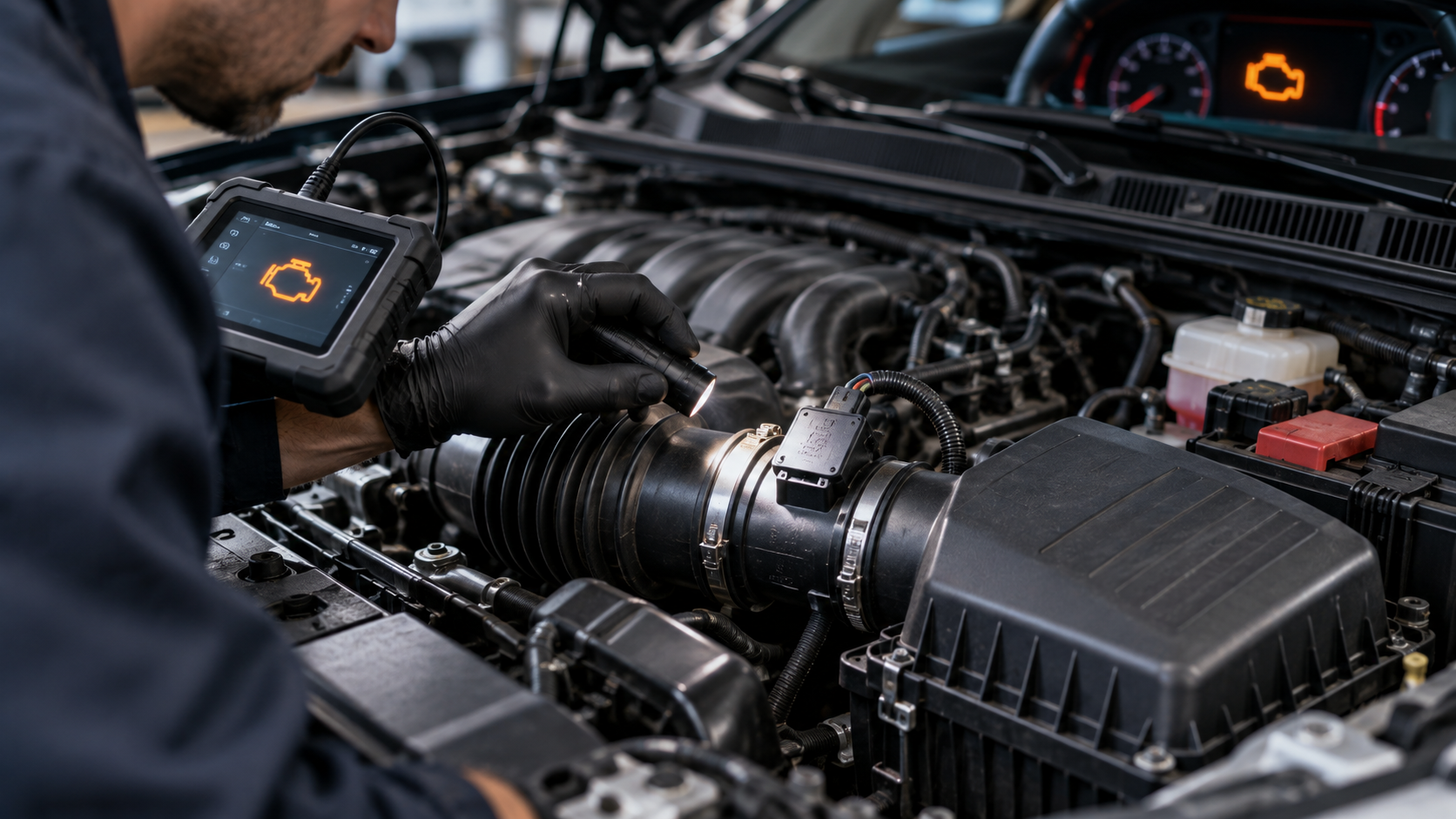
Your car starts, but something feels off. The idle is rough. Acceleration has lost its usual punch. Maybe the engine hesitates when you pull away from a stoplight, or the check engine light has suddenly joined the party.
One possible culprit is the mass airflow sensor, usually called the MAF sensor.
Common MAF sensor symptoms include rough idle, hesitation, poor acceleration, hard starting, stalling, reduced fuel economy, uneven engine response, and a check engine light. Depending on how the sensor fails, the engine may run too rich or too lean.
But here’s the catch: those symptoms are not exclusive to the MAF sensor.
A vacuum leak, dirty throttle body, weak fuel pump, failing oxygen sensor, ignition problem, clogged air filter, leaking intake hose, or even bad wiring can feel surprisingly similar from the driver’s seat.
So a MAF sensor should be tested, not blamed automatically.
What Does a MAF Sensor Do?
The mass airflow sensor measures how much air enters the engine.
That information goes to the engine control module, or ECM. The computer then uses the airflow data along with information from other sensors to calculate how much fuel the engine needs.
Think of the engine as constantly trying to maintain the correct recipe.
Air comes in. Fuel is added. Spark happens. The mixture burns.
If the computer receives incorrect airflow information, the fuel calculation can be wrong. Too much fuel may be added, or not enough.
That’s when drivability problems begin.
Where Is the MAF Sensor Located?
On many gasoline vehicles, the MAF sensor sits in the intake tract between the air filter box and the throttle body.
You will often see an electrical connector attached to a small sensor mounted in the plastic intake tube or air filter housing.
Some vehicles use a combined sensor that may also measure intake-air temperature.
And not every engine uses a MAF sensor in exactly the same way. Some engines rely more heavily on manifold absolute pressure, or MAP, sensor data.
So before buying parts, confirm your vehicle actually has the component you plan to replace.
Most Common MAF Sensor Symptoms
- Check engine light
- Rough or unstable idle
- Hesitation during acceleration
- Poor throttle response
- Reduced engine power
- Hard starting
- Stalling after startup or at idle
- Poor fuel economy
- Engine running too rich
- Engine running too lean
- Surging during steady-speed driving
- Black exhaust smoke in severe rich-running cases
Not every bad MAF sensor produces every symptom.
Some sensors fail gradually. Others become contaminated and start sending slightly inaccurate readings long before the car becomes difficult to drive.
Why a Bad MAF Sensor Causes Rough Idle
Idle requires surprisingly precise control.
The throttle opening is small, airflow is relatively low, and the engine computer constantly makes tiny corrections to keep the engine running smoothly.
If the MAF sensor reports the wrong amount of incoming air, the fuel mixture can drift away from what the engine needs.
You may feel the engine shaking slightly at a stoplight. RPM may rise and fall. In more severe cases, the engine may stall when you come to a stop.
But rough idle alone is not enough to diagnose a MAF sensor.
Vacuum leaks are especially good at producing similar symptoms.
Hesitation When You Accelerate
You press the gas pedal expecting the car to move.
Instead, there’s a short pause. Maybe the engine stumbles, then suddenly catches up.
This can happen when airflow changes quickly but the MAF sensor does not report that change accurately.
The engine control module may briefly deliver the wrong amount of fuel.
A contaminated sensor can sometimes respond slowly rather than fail completely.
That can make acceleration feel inconsistent instead of completely broken.
Poor Acceleration and Loss of Power
A bad MAF sensor can make the engine feel lazy.
You may notice the car struggles more during highway merging, uphill driving, or passing.
In some cases, the engine computer detects airflow data that seems unreasonable and switches to substitute values.
The car may still run, but performance can be reduced.
This is sometimes described as a failsafe or limp-type strategy, though the exact behavior varies by manufacturer.
MAF Sensor Symptoms at a Glance
| Symptom | How It May Feel | Other Possible Causes |
|---|---|---|
| Rough idle | Engine shakes or RPM moves up and down | Vacuum leak, ignition issue, dirty throttle body |
| Hesitation | Delay or stumble when pressing the accelerator | Fuel pressure issue, ignition problem, throttle fault |
| Poor acceleration | Car feels weak under load | Fuel delivery, clogged exhaust, turbo problem |
| Hard starting | Long crank or engine starts and stalls | Battery, fuel pressure, crank sensor, ignition |
| Rich running | Fuel smell, poor MPG, sometimes black smoke | Injector issue, oxygen sensor, excessive fuel pressure |
| Lean running | Hesitation, roughness, possible misfire | Vacuum leak, weak fuel pump, clogged injector |
| Check engine light | Warning light with or without drivability issues | Many engine-management faults |
Can a Bad MAF Sensor Cause Hard Starting?
Yes, although it is not always the first symptom.
During startup, the engine computer needs enough information to calculate an appropriate fuel mixture.
If the MAF signal is badly inaccurate, the mixture may become too rich or too lean.
The engine might crank longer than usual, start roughly, or start and immediately stall.
That said, hard starting has a long suspect list.
Battery voltage, fuel pressure, ignition, coolant-temperature data, crankshaft-position sensing, and injector operation can all affect starting.
Can a MAF Sensor Cause Stalling?
It can.
Stalling often appears when airflow changes rapidly, such as when you release the accelerator and the engine returns to idle.
If the ECM cannot correctly estimate incoming air, the idle mixture may briefly move too far rich or lean.
The engine may stumble and die.
Some drivers notice this most often when approaching a stop sign, shifting into gear, or turning the air conditioner on at idle.
Again, don’t assume. Vacuum leaks and dirty throttle bodies can behave almost the same way.
Can a Bad MAF Sensor Hurt Fuel Economy?
Yes.
If airflow is reported incorrectly, fuel delivery can become inefficient.
A sensor that causes the engine to run rich may increase fuel consumption noticeably.
Even if the oxygen sensors compensate during some driving conditions, the engine may still use more fuel than normal.
If your gas mileage drops at the same time the engine develops hesitation, rough idle, or a check engine light, airflow measurement deserves attention.
Rich vs. Lean MAF Sensor Problems
A faulty MAF sensor does not always push the engine in the same direction.
If airflow is underreported, the ECM may command too little fuel and the engine can run lean.
If airflow is overreported, the computer may add too much fuel and the engine can run rich.
That difference changes the symptoms you may notice.
| Condition | Possible Symptoms | What May Be Happening |
|---|---|---|
| Lean mixture | Hesitation, rough idle, misfire, weak acceleration | Too little fuel for the actual amount of air |
| Rich mixture | Poor MPG, fuel smell, rough running, black smoke | Too much fuel for the actual amount of air |
| Erratic MAF signal | Surging, intermittent hesitation, unstable idle | Airflow reading changes unpredictably |
| No useful signal | Check engine light, reduced performance, substitute-data operation | ECM may estimate airflow from other information |
Check Engine Light and MAF-Related Trouble Codes
A bad or contaminated MAF sensor can trigger a check engine light.
Common mass-airflow-related diagnostic trouble codes include P0100, P0101, P0102, P0103, and P0104.
P0101 is especially common and generally indicates that the MAF sensor signal does not match the expected operating range or performance.
But here’s where diagnostics gets interesting.
A P0101 code does not automatically mean the sensor itself has failed.
The computer is basically saying, “The airflow information doesn’t make sense.”
That could happen because of a dirty sensor, intake leak, wiring fault, restricted air filter, damaged intake tube, or another engine-management problem.
Can a Vacuum Leak Look Like a Bad MAF Sensor?
Very easily.
The MAF sensor measures air entering through the intake system.
If extra air enters after the sensor through a cracked hose, split intake boot, leaking gasket, or disconnected vacuum line, that air is not measured.
The engine computer thinks less air entered than actually did.
The result is often a lean mixture.
You may get rough idle, hesitation, lean trouble codes, and fuel-trim numbers that look suspicious.
Replacing the MAF sensor will not fix unmetered air entering through a cracked hose.
Inspect the Intake Tube Carefully
One of the easiest checks is also one of the most frequently overlooked.
Look at the intake duct between the MAF sensor and throttle body.
Flexible rubber or plastic sections can develop cracks, especially underneath where you cannot see them from above.
A crack may open wider when the engine moves under acceleration.
That can create a vehicle that idles reasonably well but hesitates badly under load.
Before replacing an expensive sensor, spend a minute squeezing and inspecting the intake tube.
Why MAF Sensors Get Dirty
The sensing element needs to remain clean because it measures airflow very precisely.
Over time, contamination can build up.
Dust that gets past the air filter, oil vapor from the intake system, environmental debris, and residue from certain aftermarket air-filter treatments can affect sensor accuracy.
A MAF sensor does not need to look filthy to give incorrect readings.
The sensing element itself is small and delicate.
Can You Clean a MAF Sensor?
Sometimes cleaning helps, especially if the problem is contamination rather than electrical or internal sensor failure.
But the cleaning method matters.
Use a cleaner specifically labeled for mass airflow sensors if cleaning is appropriate for your sensor design.
Do not scrub the sensing element with a rag, cotton swab, brush, or screwdriver.
And don’t blast it with aggressive solvents that can leave residue or damage delicate components.
The idea is to remove contamination without physically touching the sensing element.
Basic MAF Sensor Cleaning Process
- Make sure the ignition is off and the engine is cool.
- Locate the MAF sensor in the intake system.
- Disconnect the electrical connector carefully.
- Remove the sensor if required for access.
- Inspect the housing and sensing element without touching it.
- Apply a cleaner designed specifically for MAF sensors.
- Allow the sensor to dry completely.
- Reinstall it securely and reconnect the electrical connector.
- Check that intake clamps and hoses are properly fitted.
If cleaning changes nothing and testing still shows a bad signal, replacement may be needed.
Should You Disconnect the MAF Sensor to Test It?
You may hear the advice: unplug the MAF sensor, start the car, and see whether it runs better.
This can provide a clue on some vehicles, but it is not a definitive test.
When the MAF is disconnected, many engine computers switch to substitute airflow calculations based on throttle position, engine speed, manifold pressure, and other data.
If the engine suddenly runs better, the MAF signal may indeed be suspicious.
But the improvement can also happen because the computer has changed strategies and is masking another fault.
Treat the unplug test as a clue, not a verdict.
Can You Drive With a Bad MAF Sensor?
A car with a mildly inaccurate MAF sensor may continue to run.
But whether driving is wise depends on the symptoms.
If the engine is hesitating badly, stalling, misfiring, or losing power in traffic, driving can become unsafe.
Running excessively rich for a long time can also harm the catalytic converter because unburned fuel may enter the exhaust.
Running excessively lean can increase combustion temperatures and cause poor performance or misfires.
If the check engine light is flashing, stop treating the problem as a minor sensor annoyance. A flashing light commonly indicates a severe misfire that can damage the catalytic converter.
MAF Sensor vs. MAP Sensor
The two sensors sound similar, but they do different jobs.
A MAF sensor directly measures incoming airflow.
A MAP sensor measures pressure inside the intake manifold.
The engine computer can use manifold pressure, engine speed, throttle position, intake temperature, and other information to estimate airflow.
Some engines use both sensors.
Others rely primarily on one system.
That is why a diagnosis should always match the actual engine design.
Can a Bad MAF Sensor Cause Misfires?
Yes, indirectly.
If incorrect airflow data causes the fuel mixture to become too lean or too rich, combustion can become unstable.
That may trigger misfire codes.
But if one specific cylinder consistently misfires, the MAF sensor is usually not the first thing to suspect.
A MAF problem affects the overall airflow calculation and generally influences multiple cylinders.
A single-cylinder misfire points more strongly toward that cylinder’s spark plug, ignition coil, injector, compression, or another localized issue.
Can a MAF Sensor Cause Surging?
It can.
Surging feels like the vehicle is gently speeding up and slowing down even though your foot stays in the same position.
If the airflow signal jumps around, fuel delivery may follow those incorrect readings.
The engine can alternate between slightly richer and leaner operation.
This may be especially noticeable during steady-speed cruising.
Transmission behavior can sometimes make the sensation confusing, so engine data and road testing help separate the causes.
What Does a Mechanic Check?
A technician normally starts with the symptoms, diagnostic trouble codes, and live data.
MAF readings can be observed with a scan tool while the engine idles and while RPM or engine load changes.
The exact expected airflow depends on engine displacement, speed, load, altitude, temperature, and engine design.
Rather than relying on one universal number, technicians compare the sensor’s behavior with expected values and other engine data.
Fuel trims are especially useful.
If the computer is adding a large amount of fuel to compensate for an apparent lean condition, the technician may inspect for vacuum leaks, intake leaks, low fuel pressure, and inaccurate airflow data.
Why Fuel Trim Data Matters
Modern engine computers constantly adjust fuel delivery.
These corrections are shown as short-term and long-term fuel trims.
Positive fuel trim means the computer is adding fuel.
Negative fuel trim means it is removing fuel.
Large corrections can provide useful diagnostic direction.
But fuel trims alone do not identify the failed part.
A large positive trim could come from a vacuum leak, low fuel pressure, restricted injector, exhaust leak near an oxygen sensor, or an airflow measurement problem.
What About the Electrical Connector?
A perfectly good sensor cannot send reliable information through damaged wiring.
Inspect the MAF connector for corrosion, bent terminals, loose pins, damaged insulation, or wiring that has rubbed against another component.
Intermittent wiring faults can be especially frustrating.
The car may run perfectly for days, hit a bump, then suddenly stumble and trigger a warning light.
If moving the harness changes the engine behavior, wiring deserves careful attention.
Can a Dirty Air Filter Damage the MAF Sensor?
A severely restricted air filter can reduce airflow and change engine performance.
A damaged or poorly fitted filter can also allow dirt to pass into the intake tract.
That contamination may eventually reach the MAF sensor.
Replacing the sensor while leaving a broken air filter housing or improperly installed filter in place is not a great plan.
Check the entire intake path.
Aftermarket Air Filters and MAF Problems
Some reusable filters use oil as part of their filtration system.
If too much oil is applied, residue can potentially reach the MAF sensing element.
This does not mean every reusable filter causes MAF problems.
It means correct maintenance matters.
If your MAF symptoms appeared soon after servicing an oiled filter, contamination is worth considering.
Can Throttle Body Problems Feel Similar?
Yes.
A dirty throttle body can cause unstable idle, hesitation, or poor throttle response.
Electronic throttle systems also rely on sensors and motors that can create drivability problems if they malfunction.
When MAF readings look reasonable but idle is unstable, throttle-body condition may be part of the investigation.
Some vehicles require an idle or throttle relearn procedure after cleaning or battery disconnection.
Could It Be the Oxygen Sensor Instead?
Possibly.
Oxygen sensors monitor the exhaust and help the engine computer adjust fuel delivery.
A faulty oxygen sensor can affect fuel mixture, but its role is different from the MAF sensor’s.
The MAF tells the computer how much air is entering.
The oxygen sensor reports what happened after combustion.
They are two parts of the same feedback system.
A code involving fuel mixture does not automatically identify either sensor as the cause.
Can Low Fuel Pressure Mimic MAF Sensor Symptoms?
Definitely.
If the fuel pump cannot maintain adequate pressure, the engine may hesitate or lose power under acceleration.
The computer may see a lean condition and increase fuel trim.
From the driver’s seat, it can feel very similar to incorrect MAF data.
Fuel-pressure testing can help separate an airflow problem from a fuel-delivery problem.
When a MAF Sensor Usually Needs Replacement
Cleaning makes sense only when contamination is the issue.
If the sensor has an internal electrical failure, damaged sensing element, broken housing, or signal that remains inaccurate after proper inspection and cleaning, replacement may be appropriate.
Replacement also makes sense when testing confirms that the signal does not respond correctly to changing engine airflow.
The key word there is confirms.
Replacing the MAF simply because a code contains the words “mass airflow” is how good parts end up in trash cans.
OEM vs. Cheap Replacement MAF Sensors
MAF sensors are precision electronic components.
Very inexpensive aftermarket sensors sometimes create new problems because their calibration does not match the original part closely enough.
The engine may run, but fuel trims, idle quality, or throttle response may remain incorrect.
An OEM sensor or a high-quality replacement from a reputable manufacturer is often the safer route when replacement is actually needed.
A bargain sensor that requires replacement twice is no bargain.
What to Check Before Buying a New Sensor
- Confirm the vehicle actually uses a MAF sensor.
- Scan for diagnostic trouble codes.
- Inspect the air filter and filter housing.
- Check the intake tube for cracks or loose clamps.
- Inspect vacuum lines for leaks.
- Look at MAF live data if a scan tool is available.
- Check fuel trims.
- Inspect the sensor connector and wiring.
- Consider careful cleaning if contamination is visible or likely.
- Rule out ignition and fuel-delivery problems when symptoms overlap.
That short checklist can prevent a lot of unnecessary parts swapping.
Can a New MAF Sensor Need Relearning?
Sometimes the engine control module needs time to adapt after airflow problems are corrected.
Some vehicles may benefit from a specific relearn or adaptation procedure depending on manufacturer design.
Others simply adjust as you drive.
If the old sensor caused large fuel corrections, the engine may not instantly feel perfect after replacement.
Stored adaptations and trouble codes may need to be cleared according to the proper service procedure.
Why the Problem Can Come and Go
Intermittent MAF problems are common enough to be annoying.
A sensor may work reasonably well when cold but misbehave once hot.
A loose terminal may lose contact when the engine vibrates.
A crack in an intake hose may open only when the engine moves under load.
And contamination can create readings that are inaccurate only within part of the airflow range.
That’s why one quick idle test in the driveway does not always reveal the fault.
Cold Weather and MAF Sensor Behavior
Cold weather changes air density.
The MAF sensor is designed to account for the mass of incoming air, so normal temperature changes should not cause a healthy sensor to fail.
But existing intake leaks, wiring problems, or contamination may become more noticeable under certain weather conditions.
Cold starts also demand different fueling than a warm engine, so a marginal sensor can sometimes create stronger symptoms first thing in the morning.
Can a MAF Sensor Stop the Car From Starting Completely?
It is possible on some vehicles, but a total no-start is less common than rough running or hard starting.
Many engine-management systems can substitute estimated airflow data when the MAF signal disappears.
That may allow the engine to start and run poorly rather than remain completely dead.
If the engine does not crank at all, the MAF sensor is not the first place to look.
No-crank problems are generally related to the battery, starter, starter circuit, security system, transmission range switch, or other starting-system components.
What If the Car Runs Better With the MAF Unplugged?
This is a useful clue, but don’t stop there.
With the sensor disconnected, the ECM may ignore its reading and estimate airflow instead.
If the engine suddenly runs better, the original MAF data may have been misleading the computer.
But the real reason could still be unmetered air, a wiring fault, or another condition that changes when the ECM switches strategies.
Inspect the intake and analyze live data before ordering a sensor.
Is a Bad MAF Sensor Dangerous?
The sensor itself is not usually a direct safety hazard.
The drivability problems it creates can be.
Stalling while turning through an intersection, severe hesitation during highway merging, or sudden loss of engine power can put you in an uncomfortable situation quickly.
If the car is running badly enough that acceleration is unpredictable, get it diagnosed rather than trying to squeeze another month out of it.
FAQ
What are the most common MAF sensor symptoms?
Common symptoms include rough idle, hesitation, poor acceleration, reduced power, hard starting, stalling, poor fuel economy, surging, and a check engine light.
Can a bad MAF sensor cause a check engine light?
Yes. Faults may trigger codes such as P0100 through P0104. A MAF-related code does not automatically prove the sensor itself is bad.
Can I clean a MAF sensor instead of replacing it?
If contamination is causing inaccurate readings, proper MAF sensor cleaner may help. An electrically damaged or failed sensor will still require replacement.
Can I drive with a bad MAF sensor?
The vehicle may still run, but severe hesitation, stalling, rich running, lean running, or misfires can make continued driving a bad idea. Diagnose the problem promptly.
Will unplugging the MAF sensor tell me if it is bad?
It can provide a clue. The engine may switch to substitute airflow calculations when the sensor is unplugged. Running better unplugged does not prove the sensor is the only problem.
Can a vacuum leak cause MAF sensor symptoms?
Yes. Air entering downstream of the MAF sensor is not measured and can create lean running, rough idle, hesitation, and fuel-trim problems.
How long does a MAF sensor last?
There is no fixed mileage at which every MAF sensor fails. Many last for years and well over 100,000 miles, while contamination, wiring damage, intake problems, or component failure can shorten service life.
Conclusion
MAF sensor symptoms can be frustrating because they overlap with so many other engine problems.
Rough idle? Could be the MAF. Could also be a vacuum leak.
Hesitation? Maybe airflow data is wrong. Or perhaps fuel pressure drops under load.
Poor fuel economy? A MAF problem can do that too, but so can oxygen-sensor issues, ignition problems, tire pressure, driving conditions, and plenty of other things.
That’s why good diagnosis starts with the whole picture.
Pay attention to when the symptoms happen.
Does the engine stumble only when cold?
Does it hesitate when you accelerate hard?
Does it idle badly but run normally at highway speed?
Did the problem begin after someone replaced the air filter?
Did you recently notice a cracked intake hose or hear a hissing sound under the hood?
These details matter.
If the check engine light is on, read the stored trouble codes. If you have access to live scan data, look at the MAF signal and fuel trims rather than simply clearing the code and hoping it stays away.
And inspect the intake carefully.
A split rubber hose after the MAF sensor can create nearly the same lean-running symptoms as an inaccurate sensor. Replacing the MAF won’t close the crack.
The same goes for low fuel pressure, ignition misfires, and vacuum leaks.
If the sensor is dirty, cleaning may help.
Use a cleaner designed for mass airflow sensors and avoid touching the delicate sensing element. Give it time to dry before reinstalling it.
If the sensor’s signal remains wrong after the intake, wiring, and related systems are checked, replacement becomes much more reasonable.
And when replacement is needed, quality matters.
A MAF sensor is not just a plastic piece with a connector attached. It is a calibrated measuring device, and the engine computer relies on its accuracy every time you press the accelerator.
An inexpensive sensor that reports slightly incorrect airflow can leave you chasing the same rough idle and fuel-trim problems you were trying to fix.
One more thing: don’t ignore severe drivability problems simply because the engine still runs.
If the vehicle stalls unexpectedly, hesitates badly during acceleration, loses significant power, or develops a flashing check engine light, get it checked.
A flashing light can indicate a serious misfire, which can damage the catalytic converter if driving continues.
For most MAF-related complaints, the repair itself isn’t the hardest part.
Finding the actual cause is.
Start with the air filter and intake duct. Look for leaks. Check the wiring. Read the codes. Look at live data where possible. Then clean or replace the sensor only when the evidence points there.
That approach takes a little longer than throwing a part at the car.
But it is usually cheaper, and more importantly, it gives you a much better chance of fixing the problem once instead of fixing the wrong thing twice.
Leave a Reply