
The steering wheel suddenly feels heavier in a parking lot. There’s a whining noise when you turn. Maybe you open the hood and notice the power steering fluid is low again, even though you topped it off last month.
At some point, the question becomes pretty obvious: is the power steering pump going bad?
A power steering pump replacement may be needed when a hydraulic steering pump can no longer create the pressure required to assist steering. Pumps can wear internally, develop leaks, suffer bearing damage, or fail after running with too little fluid.
But there’s an important catch.
Heavy steering doesn’t automatically mean the pump is bad.
Low fluid, a leaking hose, a slipping serpentine belt, a damaged steering rack, contaminated fluid, or even low tire pressure can produce similar symptoms. And many newer vehicles don’t have a hydraulic power steering pump at all. They rely on electric power steering.
So before ordering a pump and clearing your Saturday afternoon, it’s worth figuring out what system your car actually has and whether the pump is really the source of the trouble.
What Does a Power Steering Pump Actually Do?
Traditional hydraulic power steering relies on fluid pressure.
The engine turns the power steering pump, usually through a serpentine or accessory belt. The pump pressurizes hydraulic fluid and sends that pressure toward the steering gear or rack.
When you turn the steering wheel, hydraulic pressure helps move the steering mechanism. That’s why you can maneuver a 4,000-pound vehicle into a tight parking space without wrestling the wheel like you’re driving a truck from the 1950s.
Without hydraulic assistance, the steering can still remain mechanically connected, but it may require dramatically more effort at low speed.
The pump therefore does not “steer” the car for you. It reduces the physical effort needed to move the steering system.
Does Every Car Have a Power Steering Pump?
No.
This matters because drivers sometimes search for power steering pump replacement when their vehicle doesn’t have a conventional hydraulic pump.
Modern cars may have one of several systems.
| Steering System | How Assistance Is Created | Traditional Pump? |
|---|---|---|
| Hydraulic power steering | Engine-driven pump pressurizes hydraulic fluid | Yes |
| Electro-hydraulic steering | Electric motor drives a hydraulic pump | Yes, but electrically driven |
| Electric power steering | Electric motor assists the steering column or rack | No |
| Manual steering | No power assistance | No |
If you have electric power steering, there may be no pump, reservoir, or power steering fluid to replace.
The owner’s manual or vehicle service information can help confirm the system type.
Common Signs of a Bad Power Steering Pump
A failing pump usually doesn’t announce itself with one perfect symptom. More often, several small clues appear together.
- Whining or groaning while turning the steering wheel
- Heavy steering, especially during parking
- Steering assistance that comes and goes
- Fluid leaking around the pump
- Foamy or aerated power steering fluid
- A squealing accessory belt
- Steering effort that increases at low engine speed
- Metallic noise from the pump or pulley area
The combination matters.
Heavy steering plus a loud hydraulic whine and low fluid tells a different story than heavy steering with completely normal fluid level and no pump noise.
The Classic Whining Noise
A high-pitched whining sound that changes as you turn the steering wheel is one of the most recognizable hydraulic power steering symptoms.
But even that doesn’t automatically mean the pump itself needs replacement.
A pump can whine because the fluid level is low.
When the fluid drops enough, the pump may pull air into the system. Hydraulic fluid mixed with air doesn’t behave properly, and the pump may become noisy.
Correcting the leak and properly bleeding the system may solve the problem if the pump has not already been damaged.
If it has been running dry for a while, though, internal wear may already have occurred.
Why Low Power Steering Fluid Matters
Hydraulic pumps depend on their fluid for both pressure transfer and lubrication.
Running with too little fluid can damage internal pump surfaces.
That’s why repeatedly topping off the reservoir without finding the leak is risky.
If the reservoir keeps dropping, fluid is going somewhere.
Common leak areas include the pump shaft seal, pressure hose, return hose, hose connections, reservoir, steering rack seals, and steering gear.
A small leak can slowly become a larger repair if the pump begins running low enough to damage itself.
When a Leak Means the Pump Needs Replacement
Some pumps leak directly from the pump housing or shaft seal.
If the pump itself is leaking badly, replacement may make more sense than trying to reseal it, especially when the unit also has bearing noise or pressure problems.
But a wet pump doesn’t always mean the pump is the source.
Fluid can run down from a hose connection above the pump and make the pump body look guilty.
Cleaning the area and tracing fresh fluid can help identify where the leak actually begins.
Heavy Steering Can Have Other Causes
This is where people sometimes waste money.
The steering gets heavy, a replacement pump goes in, and… nothing changes.
That’s because the pump was never the problem.
Other possible causes include:
- Low or incorrect power steering fluid
- Air trapped in the hydraulic system
- A slipping or damaged serpentine belt
- A weak automatic belt tensioner
- Restriction in a hydraulic hose
- A binding steering rack
- Worn or seized steering or suspension joints
- Underinflated front tires
- A steering column joint that is binding
- Incorrect wheel or suspension geometry
A proper diagnosis matters more than the symptom alone.
How a Mechanic Confirms the Pump Is Bad
The first step is normally a visual and functional inspection.
The technician may check the fluid level and condition, inspect the belt and tensioner, look for leaks, listen to the pump, and compare steering effort at different engine speeds.
If necessary, hydraulic pressure can be tested.
This is especially useful when the pump makes little noise but appears unable to provide enough steering assistance.
A pressure test can help separate a weak pump from problems farther downstream in the steering system.
Mechanical components are also checked because a binding rack or joint can make even a healthy pump struggle.
What Happens During Power Steering Pump Replacement?
The exact procedure depends heavily on the vehicle.
On some cars, the pump sits right at the top of the engine and is easy to reach. On others, it’s buried between the engine, frame, hoses, and accessories.
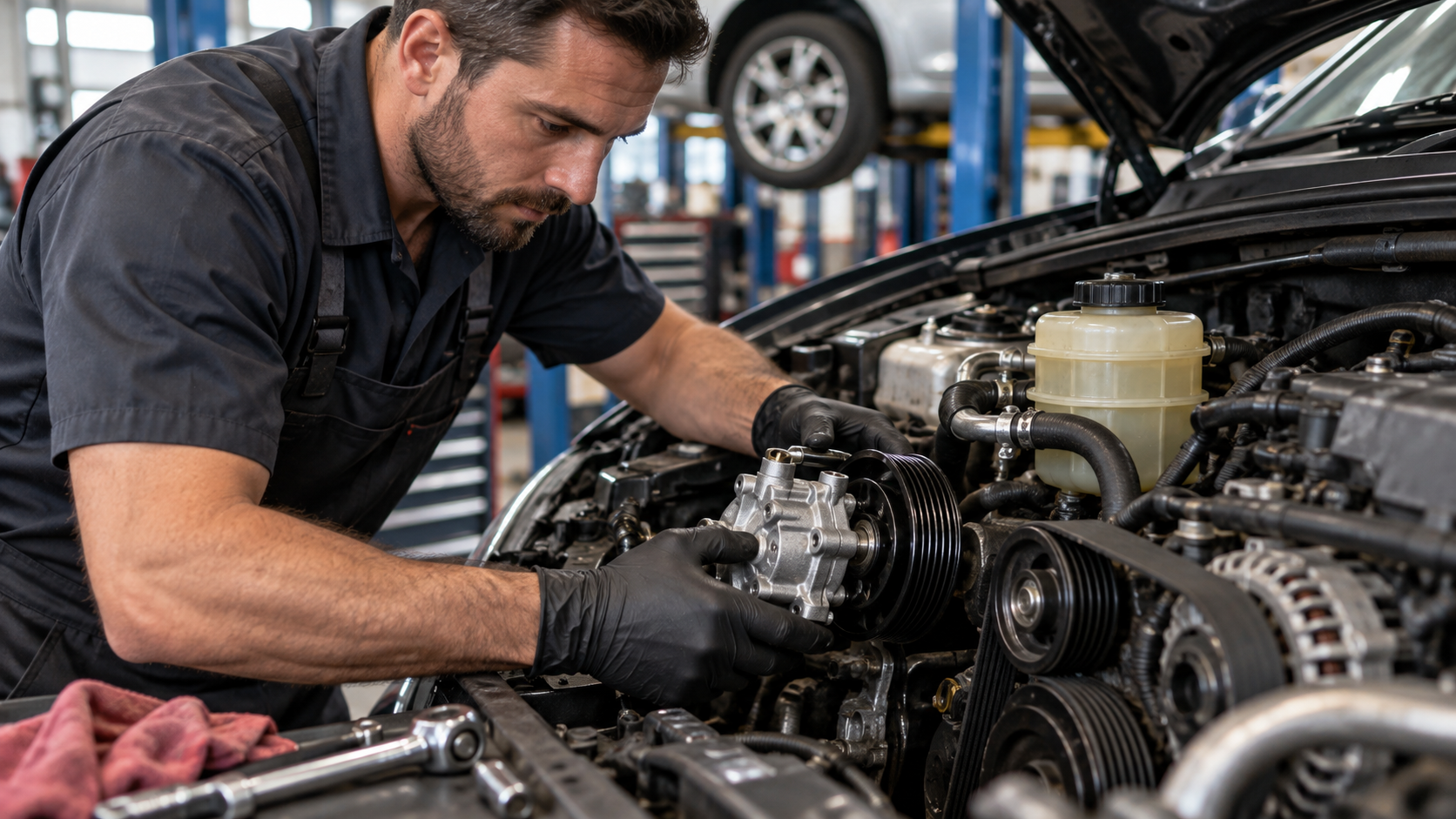
A typical repair may involve removing hydraulic fluid, loosening the belt, disconnecting pressure and return lines, removing the pump pulley when required, unbolting the pump, and installing the replacement unit.
After the new pump goes in, the system needs the correct fluid and must usually be bled to remove trapped air.
That last part isn’t optional.
Air in a hydraulic system can create noise, inconsistent steering assistance, foamy fluid, and poor pump performance.
The Basic Replacement Process
While procedures vary, the repair generally follows this kind of sequence:
- Confirm that the power steering pump is actually faulty.
- Allow the vehicle to cool and make the work area safe.
- Remove or drain enough fluid to disconnect the pump cleanly.
- Release the accessory belt where necessary.
- Disconnect the pressure and return lines.
- Remove the pump or pump-and-reservoir assembly.
- Transfer the pulley or reservoir if the new part does not include them.
- Install new seals or O-rings where specified.
- Fit the new pump and reconnect the hydraulic lines.
- Reinstall and tension the belt correctly.
- Fill the system with the manufacturer-specified fluid.
- Bleed air from the hydraulic system.
- Check for leaks, noise, and normal steering assistance.
Some vehicles require additional steps, so service information for the exact make, model, engine, and year matters.
Why the Power Steering Pump Pulley Can Be a Pain
Many hydraulic pumps use a pressed-on pulley.
That pulley doesn’t simply slide off after removing a bolt.
A special puller and installer may be required.
Trying to remove the pulley with a generic three-jaw puller or hammer can damage the pulley or pump shaft.
And if the pulley is installed too far in or left too far out, belt alignment may be wrong.
That can create belt noise, premature belt wear, or additional accessory problems.
Should You Replace the Power Steering Fluid Too?
If the pump is being replaced, fresh correct-specification fluid is usually part of the repair.
If the old fluid contains visible metal particles or heavy contamination, simply pouring fresh fluid into the reservoir may not be enough.
The rest of the hydraulic system may need flushing according to the vehicle manufacturer’s procedure.
Contaminated fluid can damage the new pump surprisingly quickly.
That’s especially important when the old pump failed internally.
Never Guess at Power Steering Fluid Type
Power steering fluids are not universally interchangeable.
Some vehicles require dedicated hydraulic fluid. Others specify certain automatic transmission fluids. European vehicles may use a hydraulic fluid with completely different chemistry.
Color isn’t a reliable guide either.
Two fluids can look similar and still have different specifications.
Check the owner’s manual, reservoir cap, or correct service documentation before adding anything.
Why a New Pump May Still Whine
You replace the pump, start the engine, turn the steering wheel… and it still whines.
Not exactly the moment you were hoping for.
The new pump may be perfectly fine.
Common reasons for post-repair noise include trapped air, low fluid, foamy fluid, a leaking suction-side connection, incorrect fluid, contaminated fluid, or a restriction elsewhere in the system.
The system may require a specific bleeding procedure.
Some vehicles are bled with the front wheels raised and the engine off first. Others require additional steps.
Follow the correct procedure rather than repeatedly turning the wheel against full lock.
Don’t Hold the Steering at Full Lock
When the steering reaches its maximum left or right position, continuing to force the wheel can place high load on a hydraulic system.
You may hear the pump tone change.
There’s usually no reason to hold the wheel firmly against the stop.
During normal driving and parking, ease off slightly once full lock is reached.
It’s a small habit, but your hydraulic system doesn’t mind it.
Power Steering Pump Replacement Cost
There is no single national price for this repair in the United States.
Parts prices differ dramatically between vehicles, and labor depends heavily on pump location and regional shop rates.
An easy-to-access pump on a common older sedan may be relatively straightforward. A pump buried in a crowded engine bay can require substantially more labor.
OEM parts, new aftermarket pumps, and remanufactured units also carry different price tags.
| Cost Factor | Why It Changes the Price |
|---|---|
| Vehicle make and model | Pump design and parts pricing vary widely |
| Labor access | Some pumps take far longer to reach and remove |
| New vs. remanufactured pump | Part prices and warranty coverage differ |
| Pulley replacement or transfer | May require extra work and special tools |
| Fluid flushing | Contaminated systems may need additional service |
| Damaged hoses | Leaking or deteriorated lines add parts and labor |
| Belt or tensioner condition | Worn drive components may be replaced at the same time |
| Local labor rates | Repair pricing varies across U.S. regions and shops |
In practice, the total can range from a few hundred dollars on simpler vehicles to well over $1,000 when parts are expensive or access is difficult.
The only useful estimate is one based on your exact vehicle.
Should You Buy a New or Remanufactured Pump?
Both options exist for many vehicles.
A new pump is built from new components. A remanufactured pump begins as an existing housing or core that is disassembled, cleaned, inspected, and rebuilt with replacement wear parts.
Quality varies.
A well-remanufactured pump from a reputable supplier can work perfectly well, while a poorly rebuilt unit may cause noise or pressure problems early.
Look at warranty coverage and supplier reputation rather than focusing only on the lowest price.
Should the Belt Be Replaced at the Same Time?
Not automatically.
But since the belt often needs to come off during the repair, it’s a convenient time to inspect it closely.
Cracks, frayed edges, glazing, contamination, or damaged ribs can justify replacement.
The tensioner and idler pulleys should also be checked.
A weak tensioner can allow belt slip, which may imitate poor pump performance.
Replacing a perfectly good belt just because the pump is out isn’t necessary, but ignoring a worn one doesn’t make much sense either.
Can a Bad Power Steering Pump Damage the Steering Rack?
Potentially, yes, especially if the pump fails internally and sends metal debris through the hydraulic system.
Contaminated fluid can circulate through hoses and the steering rack.
That’s why severe internal pump failure may require more than swapping the pump.
The system should be inspected for contamination, and flushing may be recommended.
If debris remains, it can shorten the life of the new pump or damage other hydraulic components.
Can a Bad Steering Rack Damage the New Pump?
It can.
A restricted or internally failing steering rack may force the pump to work harder than normal.
If the real cause of the original pump failure isn’t addressed, the replacement pump may also fail prematurely.
This is one reason a diagnosis based entirely on noise isn’t enough.
The whole hydraulic steering system works together.
Is It Safe to Drive With a Bad Power Steering Pump?
That depends on the severity of the problem.
A mildly noisy pump is different from a sudden total loss of power assistance.
If hydraulic assistance disappears, you may still have a mechanical steering connection, but steering effort can become very high, especially at parking speeds.
If a pump is leaking badly, fluid can potentially reach other components, and continued low-fluid operation can make the failure worse.
There is also a belt-related concern.
If the problem is actually a broken serpentine belt, the alternator and, on some engines, the water pump may also stop working.
If the battery warning comes on or engine temperature starts rising along with heavy steering, stop driving when it is safe.
What Happens If You Ignore a Failing Pump?
A slightly noisy pump may keep working for quite a while.
Or it may deteriorate quickly.
As wear progresses, you could experience louder whining, reduced assistance, increased leakage, bearing noise, or complete loss of hydraulic pressure.
A seized pump can also create problems for the accessory belt.
And if the pump is failing because the system has been running low on fluid, ignoring the leak means the underlying problem continues.
Can You Replace a Power Steering Pump Yourself?
On the right vehicle, yes.
On the wrong vehicle, the job can turn into a pretty unpleasant weekend.
The biggest variables are access, hydraulic fittings, pulley design, and bleeding procedure.
You’ll need to work safely around an accessory drive system, handle hydraulic fluid, avoid damaging pressure-line fittings, and ensure the belt is reinstalled correctly.
If a special pulley tool is required, improvising with a hammer is not the clever shortcut it might seem.
A DIY repair makes the most sense for someone already comfortable with automotive mechanical work and equipped with the correct tools and service information.
Why Cleaning Matters Before Opening Hydraulic Lines
Dirt inside a hydraulic steering system is bad news.
Before disconnecting lines, clean the surrounding area.
Once a hose is open, avoid allowing dirt, sand, shop debris, or pieces of old seals into the system.
Hydraulic components have close internal tolerances.
The fifteen seconds spent cleaning a fitting can save a lot of frustration later.
Replace the O-Rings, Not Just the Pump
Hydraulic connections often rely on O-rings or sealing washers.
Reusing an old flattened seal can turn a perfectly good pump replacement into an immediate fluid leak.
New pumps may include some seals, but don’t assume every required O-ring is in the box.
Compare the old and new components before installation.
And make sure the seal material is compatible with the specified hydraulic fluid.
What Does Air in the System Feel Like?
Air can make the steering feel inconsistent or slightly jerky.
The pump may whine loudly. Fluid in the reservoir can look foamy, milky, or full of tiny bubbles.
In some systems, the fluid level changes noticeably while the engine is running because air is circulating through the hydraulics.
A properly bled system should become quieter and smoother as the air is removed.
If bubbles continue returning, there may be an air leak on the suction side of the system.
Power Steering Pump Replacement After Running Dry
If a pump has been run with little or no fluid, don’t assume the pump is the only casualty.
First find out why the fluid disappeared.
Installing a new pump while leaving a cracked hose or leaking rack in place simply puts the new part into the same bad situation.
The system should be checked for leaks and contamination before the replacement repair is considered complete.
When the Pump Isn’t the Problem at All
Suppose you have heavy steering but the pump pressure checks out correctly.
Now the investigation moves elsewhere.
A steering rack may be binding. A ball joint may be partially seized. An upper strut bearing could be sticking. A steering shaft universal joint can corrode and become stiff.
Even badly underinflated front tires can make a steering system feel heavier than expected.
This is why replacing a pump based only on steering effort is risky.
Electric Power Steering Changes the Conversation
If your vehicle has electric power steering, a “power steering pump replacement” may not apply at all.
EPS systems rely on an electric motor, sensors, control electronics, wiring, and mechanical steering parts.
A steering warning light, low battery voltage, alternator problem, torque sensor fault, motor failure, or rack issue can reduce electric assistance.
Adding hydraulic fluid won’t help because there may be no hydraulic circuit.
Know what system is in the car before chasing parts.
How Long Does Power Steering Pump Replacement Take?
Repair time varies enormously.
On a straightforward older vehicle, an experienced technician may complete the job in a relatively short appointment.
On other vehicles, access requires removing additional components before the pump can even be reached.
Rust, seized fittings, pulley transfer, contaminated fluid, or additional leaks can also extend the repair.
If you’re booking the job at a shop, ask whether the quoted labor includes system bleeding and any required fluid service.
Can You Replace Just the Pump Without the Reservoir?
Sometimes.
Some pumps have a removable reservoir that transfers to the replacement unit. Others come as a complete pump-and-reservoir assembly.
Older plastic reservoirs can become brittle, cracked, or contaminated.
If the reservoir has an internal filter that cannot be serviced separately, replacement may make sense when contamination is present.
The correct approach depends on the vehicle and replacement part design.
What to Check After the Repair
Once the pump is replaced and the system is bled, steering should feel smooth and consistent.
Look for leaks around the pump, hoses, and fittings.
Listen for abnormal whining.
Check the fluid level again after the steering has been operated and any remaining air has moved through the system.
Also inspect belt tracking.
A pulley sitting out of alignment can create a new problem almost immediately.
FAQ
How do I know if my power steering pump needs replacement?
Common signs include whining while turning, heavy low-speed steering, fluid leaks from the pump, inconsistent assistance, and pump bearing noise. Diagnosis should also rule out low fluid, belt problems, the steering rack, and mechanical binding.
How much does power steering pump replacement cost?
Cost depends on the vehicle, pump design, labor access, part choice, and whether hoses, belts, seals, or fluid service are also needed. Simple repairs may cost a few hundred dollars, while difficult jobs can exceed $1,000.
Can I drive with a failing power steering pump?
The car may remain steerable, but steering effort can increase sharply if assistance disappears. A severe leak, belt problem, or sudden loss of steering assist deserves prompt attention.
Will a bad power steering pump make noise?
Often, yes. Whining or groaning that changes when you turn the wheel is common. However, low fluid and air in the system can produce very similar sounds.
Do I need to flush the system when replacing the pump?
If the old pump failed internally or the fluid contains contamination, flushing may be appropriate. The correct procedure depends on the vehicle and the condition of the hydraulic system.
Why is my new power steering pump still whining?
Trapped air, low fluid, incorrect fluid, an air leak, poor bleeding, a restricted hose, or another steering-system problem can make a new pump noisy.
Does every car have a power steering pump?
No. Many newer cars have electric power steering and do not use hydraulic fluid or a traditional power steering pump.
Conclusion
A power steering pump replacement sounds straightforward: old pump out, new pump in.
Sometimes it really is that simple.
But the diagnosis matters more than the part swap.
A whining hydraulic steering system may have a worn pump, but it may also be low on fluid because of a leaking hose or steering rack. Heavy steering can come from the pump, but it can also come from a slipping belt, mechanical steering bind, suspension joint, low tire pressure, or another problem.
So start with the clues.
Is the fluid low?
Does the reservoir foam?
Does the noise change when you turn the wheel?
Is the steering heavier at idle but better when engine speed rises?
Is the pump actually leaking, or is fluid running onto it from somewhere else?
Those details help separate a failed pump from the problems that merely look like one.
If the pump does need replacement, don’t ignore the rest of the hydraulic system.
Check the belt and tensioner. Inspect hoses. Use new seals where required. Fill the system with the exact fluid specification intended for the vehicle. If the old pump contaminated the fluid with debris, address that before asking the replacement pump to live in the same dirty system.
And bleed the system properly.
A brand-new pump filled with aerated fluid can sound almost as bad as the old one.
Cost varies a lot across the United States because vehicle design matters so much. Some pumps are easy to reach. Others hide deep in the engine bay and require significant disassembly.
The pump itself may also be available as a new, remanufactured, OEM, or aftermarket unit.
That is why an estimate for one car tells you very little about another.
If you’re doing the repair yourself, don’t underestimate the pulley.
Pressed-on power steering pulleys often require dedicated removal and installation tools. Incorrect pulley position can throw the serpentine belt out of alignment.
Hydraulic line fittings also deserve care. Damaging a pressure line or cross-threading a fitting can turn a pump job into a much larger repair.
There’s another point worth checking before buying anything: does your vehicle actually have hydraulic power steering?
Many newer cars use electric power steering.
They have no traditional hydraulic pump and may have no power steering fluid at all.
Heavy steering on those vehicles requires a completely different diagnostic approach involving electrical power, sensors, control modules, assist motors, and mechanical steering components.
For a hydraulic system, though, a healthy pump should provide smooth, predictable assistance without excessive noise or leaks.
If the wheel has become heavy and the pump is whining, don’t wait until steering assistance disappears completely.
Find the cause while the symptoms are still manageable.
Sometimes the answer is a hose or low fluid.
Sometimes it really is the pump.
And when power steering pump replacement is the right repair, doing the job carefully – correct part, clean fluid, fresh seals, proper pulley alignment, and thorough bleeding – gives the new pump the best chance of lasting.
Leave a Reply